USAID DEC
Improving the Health Care Waste Management and Infection, Prevention, and Control at the Regional and Department of Health Retained Hospitals in the Philippines
Sign inDEPARTMENT OF HEALTH
Improving the Health Care Waste Management and Infection, Prevention, and Control at the Regional and Department of Health Retained Hospitals in the Philippines
The Philippines is extremely sensitive to the effects of climate change, which include sea-level rise, increased frequency of extreme weather events, rising temperatures, and heavy rainfall.
2023 · 4 pages
Sign in to readA free account is required to download.
Abstract
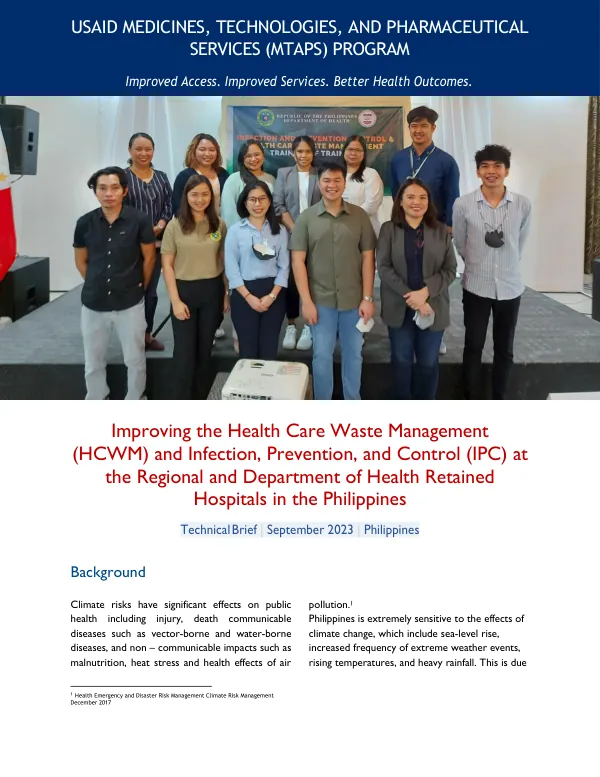
This vulnerability is due to the country's significant reliance on climate-sensitive natural resources, its long coastlines, and its history of natural disasters such as cyclones, landslides, floods, and droughts. Climate risks have significant effects on public health, including injury, death, communicable diseases such as vector-borne and water-borne diseases, and non-communicable impacts such as malnutrition, heat stress, and health effects of air pollution. The Department of Health (DOH) and the Health Facilities Development Bureau (HFDB) collaborated with the USAID Medicines, Technology and Pharmaceutical Services (MTaPS) program to build the capacity of personnel assigned for Health Care Waste Management (HCWM) and Infection, Prevention, and Control (IPC) implementation in 17 regions. A 5-day training course was conducted, which covered the basics and principles of teaching, updates on HCWM and IPC based on the Health Care Waste Management Manual, 4th Edition. The training aimed to build the capacity of participants to be trainers in their respective regions. A total of 251 participants were trained in HCWM, and 198 participants were trained in IPC. The participants were from various health facilities, including Registration, Licensing, and Enforcement Division (RLED) of Center for Health Development (CHD), Health Facility Development Unit (HFDU), environmental programs, and Provincial DOH Office (PDOHO). Through the DOH Academy, a total of 2,904 participants completed the eLearning training on HCWM, IPC, and emergency supply chain in FY23. The capacity building activity aimed to enhance IPC and HCWM practices at the health facility level and make participants ready to respond to emergencies caused by climate changes. However, challenges were encountered, including a high rate of turnover rate for trained trainers in the regions, lack of clear guidelines for the implementation of HCWM and IPC per region, and inadequate resources to cascade the training in the rest of the regions. Lessons learned and recommendations were identified, including the need for CHDs to ensure that there are enough trainers to conduct training in the regions, the importance of utilizing the DOH Academy platform to register and complete the training, and the need for clear guidelines on how facilities can dispose of HCWM to control the spread of infection and other health hazard concerns. The Department of Health needs to further strengthen the implementation of HCWM and IPC in the country, including the release of a separate guideline to institutionalize the disposal of health care waste of health facilities in each region. The sustainability plan involves ensuring that newly hired personnel assigned in HCWM and IPC are trained on the newly released manual for HCWM, facilitating regular and continuous communication with the DENR representative in each region, and utilizing eLearning through the DOH Academy with continuous professional development points to sustain the gains achieved so far.
Related documents
Documents in this collection
2024
USAID DEC
Strengthening Human Resource and Institutional Capacity in Health Care Waste Management and Infection Prevention and Control within the Department of Health and the Regions of the Philippines
Open record 2024
2024USAID DEC