USAID DEC
Mainstreaming Gender and Development in Pharmaceutical System Strengthening and Health Planning
Sign inMANAGEMENT SCIENCES FOR HEALTH
Mainstreaming Gender and Development in Pharmaceutical System Strengthening and Health Planning
The USAID Medicines, Technologies, and Pharmaceutical Services (MTaPS) Program in the Philippines aims to strengthen the country's pharmaceutical system to ensure sustainable access to and appropriate use of safe, effective, quality-assured, and affordable essential medicines, vaccines, and other health technologies and pharmaceutical services.
2024 · 3 pages
Sign in to readA free account is required to download.
Abstract
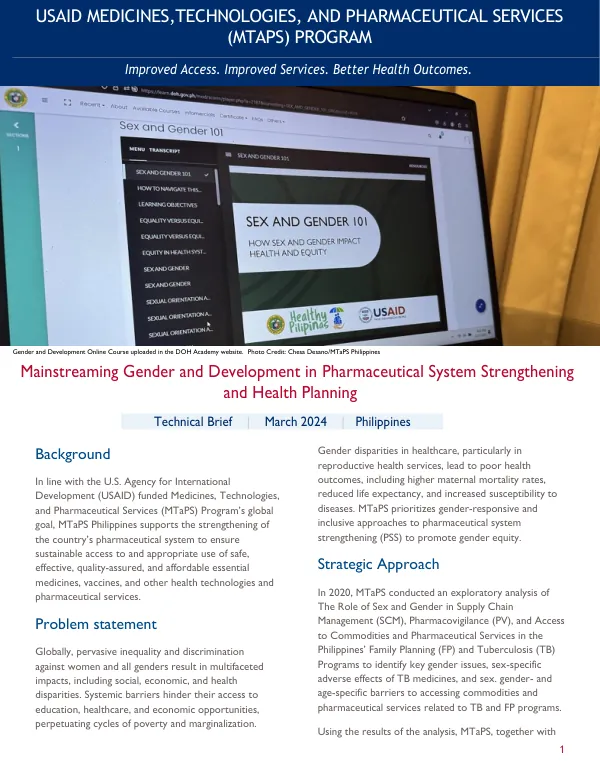
The program supports the Department of Health (DOH) in mainstreaming gender and development in pharmaceutical system strengthening and health planning. The MTaPS program conducted an exploratory analysis of the role of sex and gender in supply chain management, pharmacovigilance, and access to commodities and pharmaceutical services in the Philippines' Family Planning (FP) and Tuberculosis (TB) programs. The analysis identified key gender issues, sex-specific adverse effects of TB medicines, and sex, gender, and age-specific barriers to accessing commodities and pharmaceutical services related to TB and FP programs. The findings from the analysis highlighted the limited knowledge and data collected to analyze sex and gender impact on access to health services, including TB treatment and prevention services in the Philippines. The overall focus of product selection and access to FP commodities is primarily on married and unmarried women, with little to no mention of adolescents or men, who are the primary household decision-makers. Sex-disaggregated socioeconomic data is not systematically collected, and where it is collected, it is fragmented and not institutionalized and/or not analyzed or reported to address sex/gender gaps in supply chain management and pharmacovigilance. Key recommendations from the analysis highlight the importance of developing the capacity of the Gender and Development (GAD) focal points in the DOH network to mainstream gender in health planning. The overall lack of knowledge on sex and gender impacts in pharmaceutical systems suggested the need for training to address this gap. To address these gaps, MTaPS and the DOH's Health Policy Development and Planning Bureau (HPDPB) collaborated to develop a GAD eLearning course. The course is divided into three modules: Sex and Gender 101, The Role of Sex and Gender in Supply Chain Management, Pharmacovigilance, and Access to Commodities and Pharmaceutical Services in the Philippines' FP and TB Programs, and Gender Mainstreaming in Health Planning. The modules aim to provide an overview of the concepts of sex, gender, and health equity and the importance and interconnectedness in conducting gender analysis. The GAD eLearning course was delivered through a webinar attended by 272 planning officers from the DOH, Centers for Health Development (CHDs), and hospitals. After delivering the course, comments were collated to improve the modules and further localization of the content. Case studies were added to ensure that the learners understood the principles and concepts of sex and gender, especially the importance of mainstreaming gender in health planning. The course was successfully uploaded to the DOH Academy on January 4, 2024. As of February 2024, 266 learners had completed the course. To further support HPDPB in building the capacity of the GAD focal points, MTaPS shared a video recording to reiterate the key points and summary of the modules that will be used in the quarterly GAD focal person meeting to facilitate sharing of learnings from the GAD course in the DOH eLearning Academy. Lessons learned from the program highlight the importance of building the workforce's capacity in advancing outcomes around gender equity in supply chain management and pharmacovigilance and ensuring that GAD is integrated into pharmaceutical system strengthening and health planning. GAD focal points and policymakers must be educated to understand sex, gender, and pharmaceutical service strengthening and sensitized to adopt sex- and gender-sensitive policies. This necessitates strong stewardship by the HPDPB, as DOH's GAD secretariat, as this requires financial and human resources, political commitment, long-term approach, a transparent decision-making process, training, and involvement of relevant stakeholders.