OPEN UNIVERSITY
In Vitro Culture of Embryos from the African Catfish Clarias gariepinus
The in vitro culture of Arabidopsis thaliana embryos involves a series of developmental stages, each characterized by distinct morphological features.
5 pages
Sign in to readA free account is required to download.
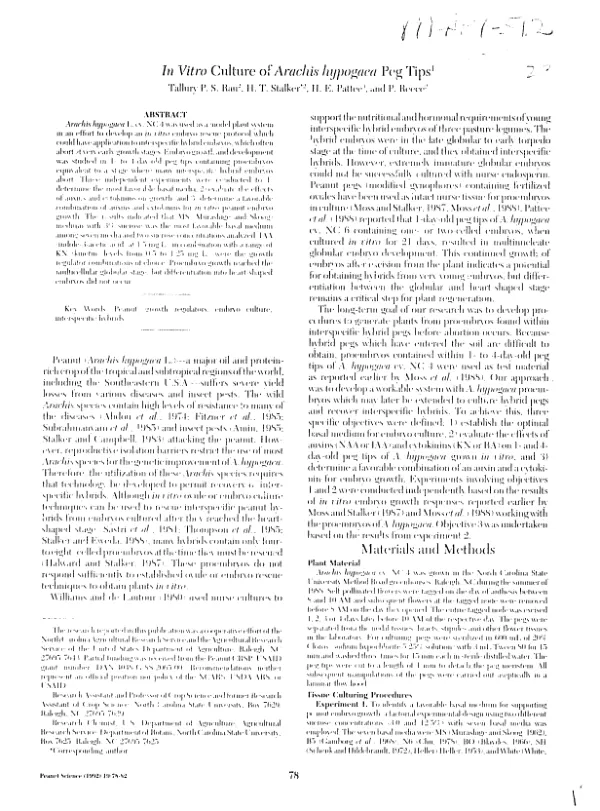
Abstract
The process begins with the formation of a proembryo, which is a compact mass of cells that will eventually give rise to the embryo. At stage D4, the proembryo is a 4-tiered, 4-celled structure with a distinct apical tier and a basal tier. The apical tier consists of two cells, while the basal tier consists of two cells that are slightly larger than the apical cells. The proembryo is surrounded by a suspensor, which is a structure that will eventually give rise to the root of the plant. As the proembryo develops, it undergoes a series of rapid cell divisions, resulting in the formation of a spherical mass of small, isodiametric cells. This stage is characterized by the differentiation of the proembryo and suspensor, and is marked by the formation of a distinct apical meristem. At stage D5, the embryo becomes a spherical mass of small, isodiametric cells with a distinct suspensor. The apical meristem is now more pronounced, and the embryo begins to take on a more globular shape. The next stage, D6, is characterized by the formation of a globular embryo. The embryo is now a compact, spherical mass of cells with a distinct apical meristem and a suspensor. As the embryo continues to develop, it undergoes a series of morphological changes, including the formation of a heart-shaped structure and the development of a distinct root and shoot system. The embryo eventually reaches a stage where it is ready to be transferred to a solid growth medium, where it will continue to develop into a mature plant. The in vitro culture of Arabidopsis thaliana embryos is a complex process that involves a series of precise and coordinated developmental stages. Understanding the morphological features of each stage is essential for the successful culture of these embryos. The culture medium used for in vitro culture of Arabidopsis thaliana embryos typically consists of a nutrient-rich solution that provides the necessary nutrients and growth factors for embryonic development. The medium is usually supplemented with plant growth regulators, such as auxins and cytokinins, which play a crucial role in regulating embryonic development. The temperature and pH of the culture medium are also critical factors that affect embryonic development. The optimal temperature for in vitro culture of Arabidopsis thaliana embryos is between 22°C and 25°C, while the optimal pH is between 5.5 and 6.5. In addition to the culture medium, the physical environment of the culture also plays a crucial role in embryonic development. The culture is usually maintained in a controlled environment, such as a growth chamber or a laminar flow hood, where the temperature, humidity, and light are carefully controlled. The in vitro culture of Arabidopsis thaliana embryos has several advantages over traditional methods of plant propagation. It allows for the rapid and efficient production of large numbers of plants, and it provides a high degree of control over the developmental process. This makes it an ideal method for plant breeding and genetic research. In conclusion, the in vitro culture of Arabidopsis thaliana embryos is a complex process that involves a series of precise and coordinated developmental stages. Understanding the morphological features of each stage is essential for the successful culture of these embryos. The culture medium, temperature, pH, and physical environment all play critical roles in embryonic development, and careful control of these factors is necessary for successful culture.