USAID DEC
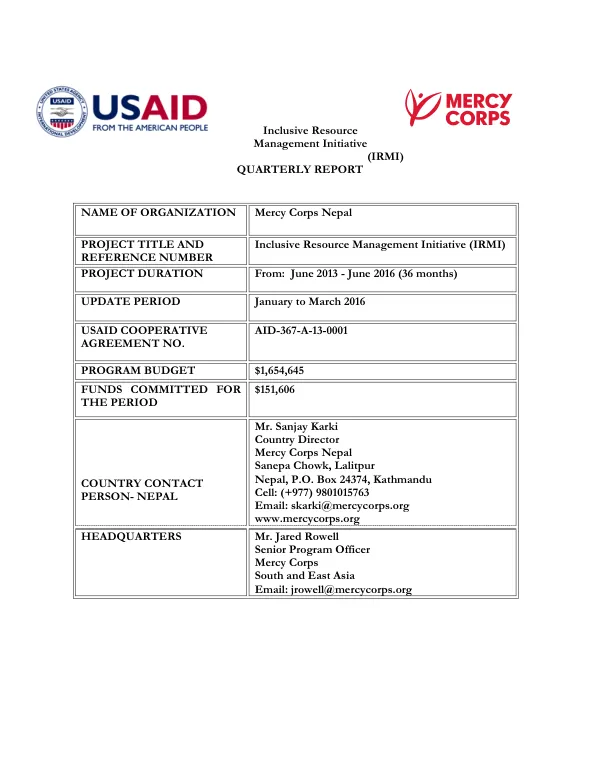
Inclusive Resource Management Initiative (IRMI) Quarterly Report
The Inclusive Resource Management Initiative (IRMI) is a three-year program implemented by Mercy Corps and two local partners, Backward Society Education (BASE) and SaharkarmiSamaj (SS), in collaboration with the USAID.
2016 · 31 pages
Sign in to readA free account is required to download.
Abstract
The program aims to enhance stability in Nepal through natural resource-based conflict resolution and inclusive natural resource management. The program targets 20 Village Development Committees (VDCs) in four districts of the western Terai, including Kailali, Bardiya, Banke, and Dang Districts. The program has reached 8,282 households and 46,592 family members, with 23,490 males and 22,102 females. The program maintains a holistic and people-to-people approach, facilitating the resolution of resource-based conflicts, promoting inclusive decision-making related to natural resource use and management, and reducing natural resource competition through joint environmental and economic initiatives. The program's major activities include facilitating natural resource-based conflict resolution, promoting inclusive management, and strengthening governance practices of Community Forest User Groups (CFUGs). The program also aims to reduce dependency on natural resources through joint environmental and economic initiatives. Key activities include facilitating conflict resolution agreements, strengthening community user groups' internal governance, raising awareness of natural resources rights and responsibilities, and supporting community participation in local government decision-making. In the current quarter, IRMI organized a four-day advanced Training of Trainers (ToT) on Natural Resource Management (NRM) Conflict Management, which was attended by 20 IRMI team members. The program also organized a 3-day Dialogue Facilitation training, which was attended by 225 key stakeholders from 13 Community Forest User Groups (CFUGs). The training enabled key stakeholders to mitigate four natural resource-related conflicts in this period. Additionally, 180 Executive Committee members, advisors, and active users participated in nine CFUG management trainings in Kailali, Bardiya, and Dang districts. A total of 1,071 community participants, including 473 males and 598 females, took part in the nineteen education sessions from the target CFUGs. These education sessions aimed to raise awareness of natural resources rights and responsibilities and promote inclusive decision-making related to natural resource use and management. The program's efforts have resulted in the mitigation of four natural resource-related conflicts, and the program continues to work towards its goal of enhancing stability in Nepal through natural resource-based conflict resolution and inclusive natural resource management. The program's activities are expected to contribute to a more peaceful and equitable society in Nepal. The program's progress is monitored through various indicators, including the number of households and family members reached, the number of conflicts mitigated, and the level of community participation in local government decision-making. The program's success is also measured through the development of conflict resolution agreements, the strengthening of community user groups' internal governance, and the reduction of dependency on natural resources. The program's sustainability is ensured through the development of a solid system to ensure the continuation of project activities, including natural resource management and economic initiatives. The program also aims to produce a handbook for IRMI key-stakeholders/Training of Trainers (ToT) on interest-based negotiation, mediation, and multi-stakeholders' dialogue, and to develop an IRMI video documentary capturing relevant success stories, case studies, and best practices.
Related documents