USAID DEC
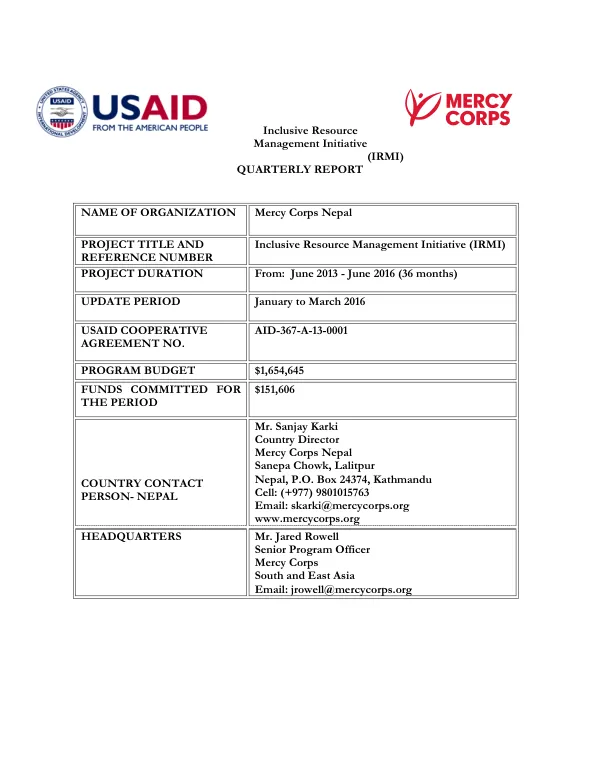
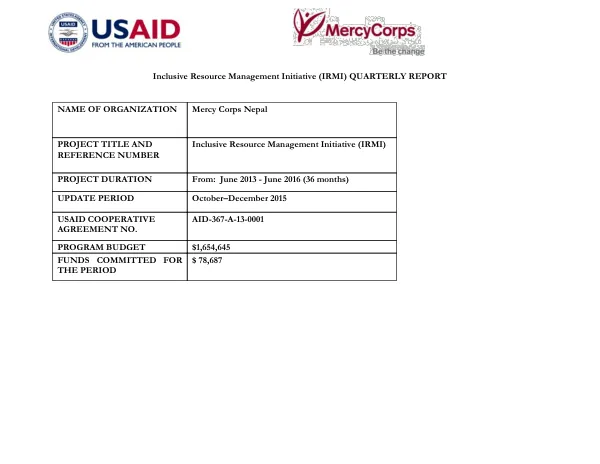
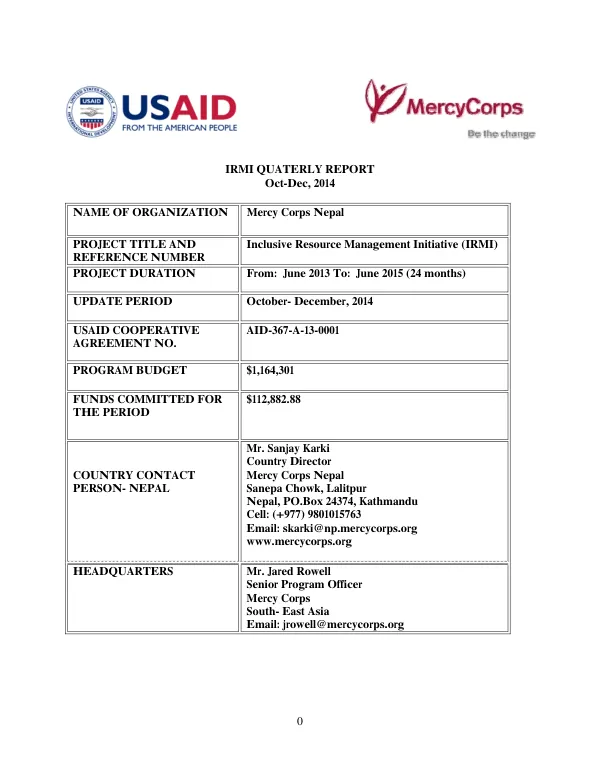
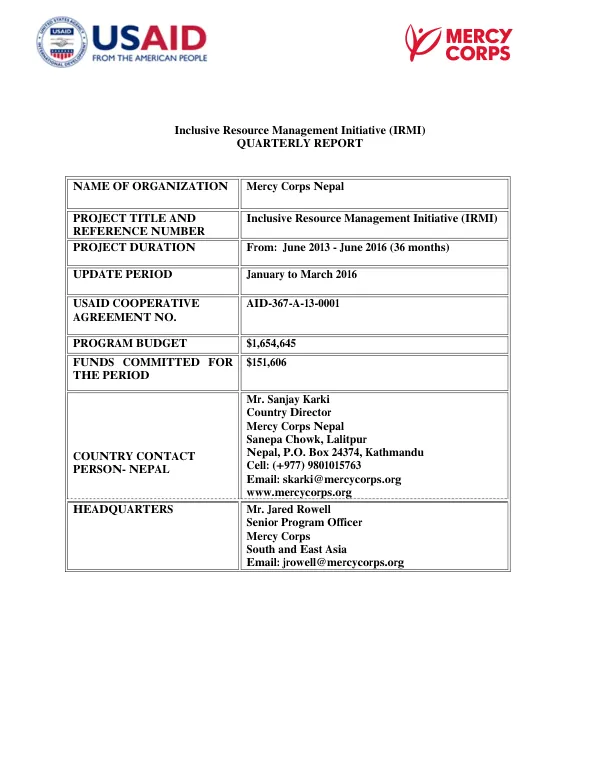
Quarterly Report: Inclusive Resource Management Initiative (IRMI)
The Inclusive Resource Management Initiative (IRMI) is a three-year program implemented by Mercy Corps in collaboration with two local partners, Backward Society Education (BASE) and SaharkarmiSamaj (SS), with funding from the United States Agency for International Development (USAID).
2016 · 31 pages
Sign in to readA free account is required to download.
Abstract
The program aims to support Nepal's transition to a more peaceful and equitable society by enhancing stability through natural resource-based conflict resolution and inclusive natural resource management. The program targets 20 Village Development Committees (VDCs) in four districts of the western Terai, including Kailali, Bardiya, Banke, and Dang Districts. Since its inception in June 2013, IRMI has reached 8,282 households and 46,592 family members, with 23,490 males and 22,102 females. The program adopts a holistic and people-to-people approach, facilitating the resolution of resource-based conflicts, promoting inclusive decision-making related to natural resource use and management, and reducing natural resource competition through joint environmental and economic initiatives. The program's major activities include facilitating natural resource-based conflict resolution, promoting inclusive management, and strengthening governance practices of Community Forest User Groups (CFUGs). IRMI also supports community participation in local government decision-making, facilitates Natural Resource Management Forums (NRMFs) to identify and resolve local conflicts, and holds advocacy workshops with relevant government bodies. Additionally, the program creates joint natural resource management initiatives, supports environmentally sustainable economic initiatives, and produces training materials and a video documentary. In the current quarter, IRMI achieved several notable milestones. The program organized a four-day advanced Training of Trainers (ToT) on Natural Resource Management (NRM) Conflict Management, which trained 20 IRMI team members. IRMI also conducted a 3-day Dialogue Facilitation training, which involved 13 Community Forest User Groups (CFUGs) and 225 key stakeholders. The training enabled key stakeholders to mitigate four natural resource-related conflicts in this period. Furthermore, 180 Executive Committee members, advisors, and active users participated in nine CFUG management trainings, and 1,071 community participants took part in nineteen education sessions. The program's efforts have led to a decrease in resource-related conflicts and an increase in inclusive decision-making related to natural resource use and management. IRMI's approach has also promoted joint environmental and economic initiatives, reducing natural resource competition and enhancing stability in the target areas. The program's success has been demonstrated through the mitigation of four natural resource-related conflicts and the participation of 1,071 community members in education sessions.