MERCY CORPS INTERNATIONAL
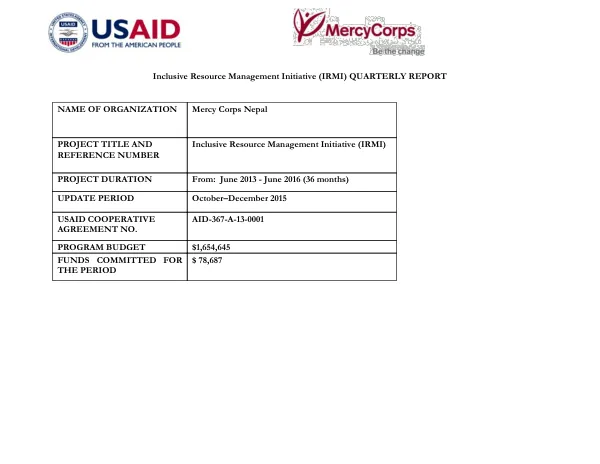
Inclusive Resource Management Initiative (IRMI) Quarterly Report
The Inclusive Resource Management Initiative (IRMI) is a three-year USAID-funded program implemented by Mercy Corps and two local partners, Backward Society Education (BASE) and Sahakarmi Samaj (SS), in Nepal.
2016 · 47 pages
Sign in to readA free account is required to download.
Abstract
The program aims to enhance stability through natural resource-based conflict resolution and inclusive natural resource management. The program targets 20 Village Development Committees (VDCs) in four districts of the western Terai, including Kailali, Bardiya, Banke, and Dang. The program has reached 8,282 households and 46,592 family members, with 23,490 male and 22,102 female participants. Mercy Corps and partners maintain a holistic and people-to-people approach, facilitating the resolution of resource-based conflicts, promoting inclusive decision-making related to natural resource use and management, and reducing natural resource competition through joint environmental and economic initiatives. The program's major activities include facilitating natural resource-based conflict resolution, promoting inclusive management, and strengthening governance practices of Community Forest User Groups (CFUGs). The program also supports community participation in local government decision-making, facilitates the Natural Resource Management Forums (NRMFs) to identify and resolve local conflicts, and holds advocacy workshops with relevant government bodies. In the current quarter, IRMI stakeholders identified and resolved local NRM conflicts, conducted a three-day intensive workshop on NRM conflict management tools, and developed a base for the Natural Resource Management Conflict Management Manual. The program also conducted a three-day training on multi-stakeholder dialogue and interest-based negotiation, settled two longstanding boundary conflicts, and conducted mid-term Group Self-Capacity Assessment exercises among 16 CFUGs. The program also organized CFUG Governance and Management Workshops, conducted a three-day training on good governance and advocacy, and raised awareness on rights and responsibilities through education sessions and radio programs. A total of 111 selected members from 20 target CFUGs participated in three joint exposure visits, and the program conducted a range of community awareness activities to empower target CFUGs to participate in official government planning processes. The program also organized VDC-level progress sharing meetings, experience-sharing meetings, and a quarterly review meeting among team members. The program has finalized 10 NRM initiatives and 10 environmentally sustainable economic initiatives, which will directly benefit 29,633 individuals from 5,259 households and 1,141 individuals from 214 households, respectively.
Related documents