USAID/NEPAL
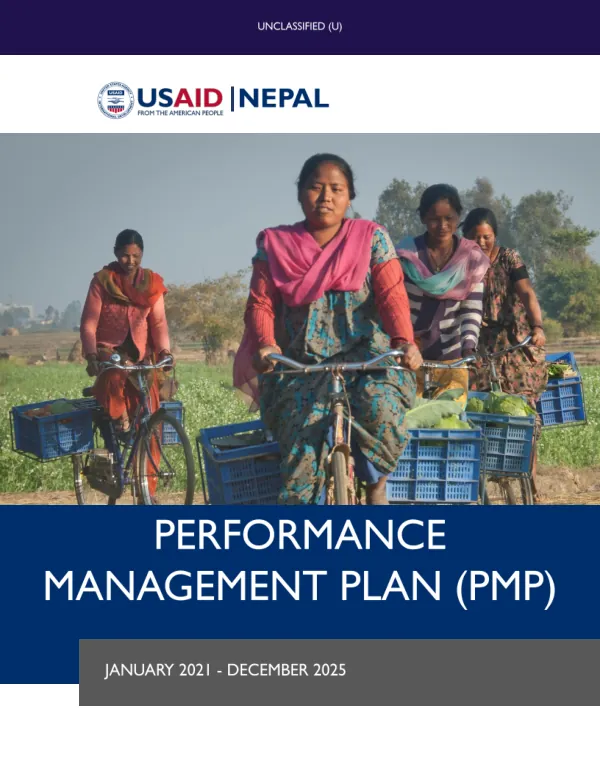
USAID Nepal PMP (2021-2025)
The performance management plan (PMP) for USAID/Nepal is a Mission-wide tool for planning and managing the processes of monitoring strategic performance, programmatic assumptions and risks, and operational context; evaluating performance and impact; and learning and adapting from evidence.
2021 · 12 pages
Sign in to readA free account is required to download.
Abstract
The PMP is guided by the ADS 201, which requires that missions develop the PMP after approval of the Country Development Cooperation Strategy (CDCS) and update it at least once a year. The overall goal of the CDCS is "A more self-reliant, prosperous, and inclusive Nepal that delivers improved democratic governance and health and education outcomes." Four Development Objectives (DOs) contribute to this goal and reflect key priority areas that will inform the Mission's projects and activities over the CDCS period. The DOs are: DO1, DO2, DO3, and DO4, which focus on democratic governance, economic growth, health and education systems, and natural resource management and disaster risk reduction, respectively. DO1 aims to strengthen both structural governance institutions and functional governance components to create a more effective, participatory, and equitable democratic system. This will be achieved through three Intermediate Results (IRs): IR 1.1, IR 1.2, and IR 1.3, which focus on strengthening the supply side of democratic institutions, improving equality under the law for women, youth, and marginalized communities, and strengthening citizen demand for democracy, respectively. DO2 aims to foster broad-based and inclusive economic growth by supporting high-growth sectors that demonstrate potential to meet domestic market demand, expand trade, generate income and employment, and reduce poverty. This will be achieved through four IRs: IR 2.1, IR 2.2, IR 2.3, and IR 2.4, which focus on promoting inclusive, private sector-driven growth in agriculture, increasing the competitiveness of select high-growth sectors, improving economic governance and the business enabling environment, and integrating marginalized and vulnerable communities into market systems, respectively. DO3 aims to contribute to strengthening Nepal's health and education systems by improving their quality, equity, and resilience. This will be achieved through three IRs: IR 3.1, IR 3.2, and IR 3.3, which focus on improving the quality of health and education services, improving equitable access to health and education services, and increasing the capacity of health and education systems to prepare for and recover from shocks, respectively. DO4 aims to combine policy and planning efforts and site-based activities to enhance natural resource management and disaster risk reduction. This will be achieved through four IRs: IR 4.1, IR 4.2, IR 4.3, and IR 4.4, which focus on enhancing natural resources conservation, improving the sustainability of the energy sector, strengthening disaster risk management systems, and increasing the resilience of women, marginalized, and vulnerable groups, respectively. USAID/Nepal's learning approach will promote accountability, and evidence-based programming. The Mission will utilize Collaborating, Learning, and Adapting (CLA) techniques to continuously monitor progress, evaluate performance and impact of its activities, learn from a wide variety of data sources, and adapt its implementation to achieve better results. The PMP will enable the Mission to continuously learn and adapt to improve ongoing and future programming. The PMP is a dynamic document that will remain flexible to adapt to operational and contextual changes throughout the CDCS period. The Mission will review and update the PMP annually to reflect the operational and programmatic changes. The changes, along with their rationale, will be maintained at a modification log for future references.
Related documents