USAID
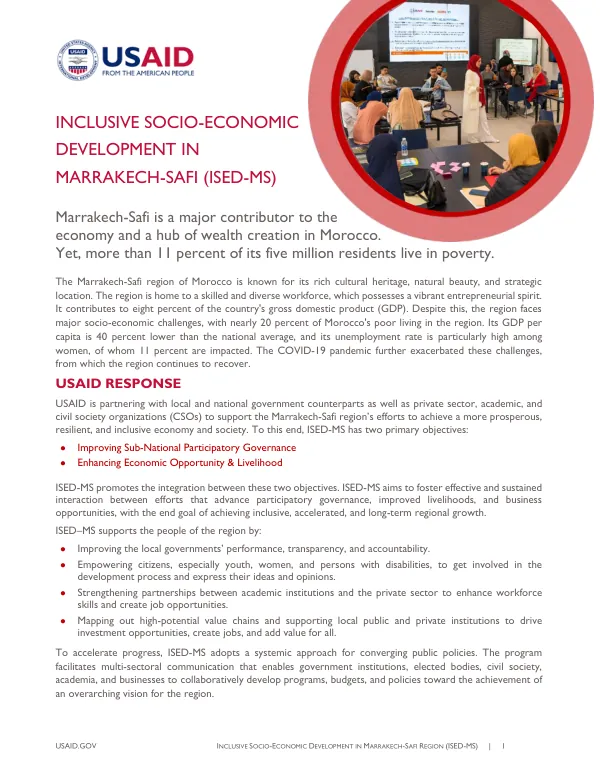
Inclusive Socio-Economic Development in Marrakech-Safi Region (ISED-MS)
The Marrakech-Safi region in Morocco is a significant contributor to the country's economy, accounting for eight percent of the gross domestic product (GDP).
2023 · 2 pages
Sign in to readA free account is required to download.
Abstract
However, the region faces substantial socio-economic challenges, with nearly 20 percent of Morocco's poor residing there. The region's GDP per capita is 40 percent lower than the national average, and its unemployment rate is particularly high among women, with 11 percent impacted. The COVID-19 pandemic exacerbated these challenges, from which the region continues to recover. To address these challenges, the USAID Inclusive Socio-Economic Development in Marrakech-Safi Region (ISED-MS) program was established. The program aims to foster a more prosperous, resilient, and inclusive economy and society in the region. ISED-MS has two primary objectives: improving sub-national participatory governance and enhancing economic opportunity and livelihoods. The program promotes the integration of these objectives to achieve inclusive, accelerated, and long-term regional growth. ISED-MS supports the people of the region by improving local governments' performance, transparency, and accountability. The program empowers citizens, especially youth, women, and persons with disabilities, to participate in the development process and express their ideas and opinions. ISED-MS also strengthens partnerships between academic institutions and the private sector to enhance workforce skills and create job opportunities. Additionally, the program maps out high-potential value chains and supports local public and private institutions to drive investment opportunities, create jobs, and add value for all. To accelerate progress, ISED-MS adopts a systemic approach for converging public policies. The program facilitates multi-sectoral communication that enables government institutions, elected bodies, civil society, academia, and businesses to collaboratively develop programs, budgets, and policies toward the achievement of an overarching vision for the region. ISED-MS has made significant progress in achieving its objectives, including strengthening participatory governance, enhancing economic opportunity and livelihoods, and amplifying the roles of citizens and civil society organizations in sub-national governance. Key results achieved to date include comprehensive engagement and outreach, with close to 400 activities engaging a total of 2,396 individuals from government, civil society, the private sector, academia, and private citizens. Participatory governance has been strengthened, with the Self-Assessment and Organizational Assessment Approach mainstreamed across communes in partnership with the DGCT. The program has also completed two entrepreneurship cohorts and established communal forums for economic inclusion. Sub-national government capacity building has been deepened, with 24 communes focusing on enhancing their management performance and responsiveness. Citizen and CSO governance roles have been amplified, with 14 events conducted to foster interactive platforms for collaborative governance. Employability initiatives have been enhanced, with the Impact Academy attracting 446 applicants and training 16 local trainers. Innovation and business ecosystem advancement has been promoted, with 13 bootcamps hosted and 86 entrepreneurs prepared for Demo Day. Cross-cutting achievements and EG-LG convergence have been made, with significant strides in aligning Economic Governance and Local Governance initiatives.