THE BILL AND MELINDA GATES FOUNDATION
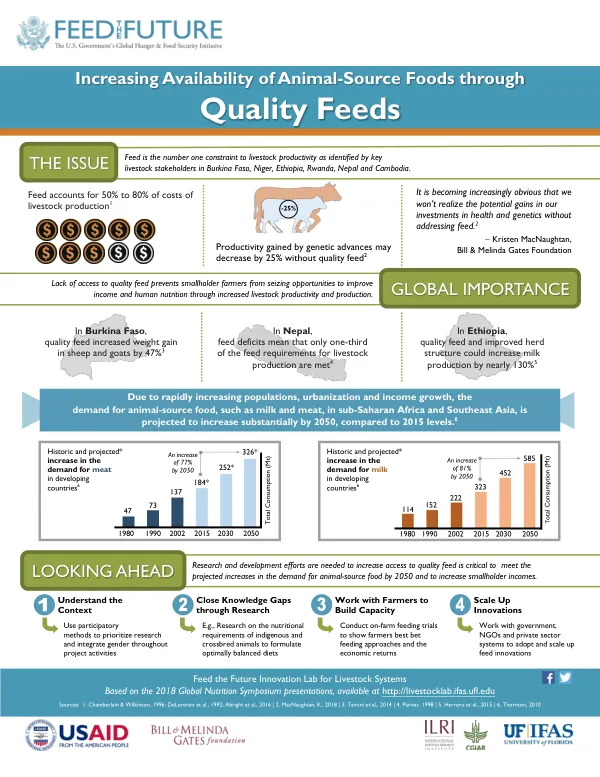
Increasing Availability of Animal-Source Foods through Quality Feeds
Animal-source food demand is projected to increase substantially by 2050, driven by rapidly growing populations, urbanization, and income growth in sub-Saharan Africa and Southeast Asia.
2018 · 1 pages
Sign in to readA free account is required to download.
Abstract
The demand for milk and meat is expected to rise by 77% and 81%, respectively, compared to 2015 levels. This growth presents opportunities for smallholder farmers to improve income and human nutrition through increased livestock productivity and production. However, a lack of access to quality feed prevents smallholder farmers from seizing these opportunities. Feed accounts for 50% to 80% of the costs of livestock production, and productivity gains from genetic advances may decrease by 25% without quality feed. In some countries, such as Nepal, feed deficits mean that only one-third of the feed requirements for livestock production are met. In contrast, quality feed has been shown to increase weight gain in sheep and goats by 47% in Burkina Faso and milk production by nearly 130% in Ethiopia. Research and development efforts are needed to increase access to quality feed and address the knowledge gaps in this area. Conducting on-farm feeding trials can help show farmers the best feeding approaches and the economic returns. Scaling up innovations in feed production and distribution requires collaboration with government, NGOs, and the private sector. Participatory methods can be used to prioritize research and integrate gender throughout project activities. Historically, the demand for meat and milk in developing countries has increased significantly. Between 1980 and 2015, the demand for meat increased from 47 million tons to 252 million tons, while the demand for milk increased from 114 million tons to 452 million tons. By 2050, the demand for meat is projected to reach 326 million tons, and the demand for milk is projected to reach 585 million tons. These increases present significant opportunities for smallholder farmers to improve their incomes and contribute to human nutrition.
Related documents