BREAKTHROUGH ACTION
Increasing Care Seeking for Children with Fever Among Women in Sokoto State
Increasing Care Seeking for Children with Fever Among Women in Sokoto State began with a behavioral surveillance survey conducted by the Breakthrough RESEARCH project.
2021 · 2 pages
Sign in to readA free account is required to download.
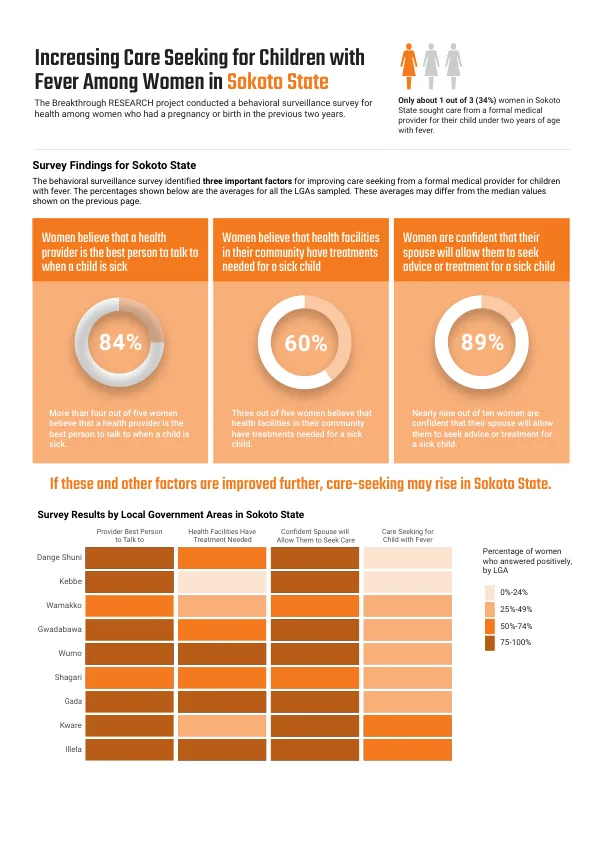
Abstract
The survey aimed to identify factors influencing care seeking from a formal medical provider for children under two years of age with fever. The survey targeted women who had a pregnancy or birth in the previous two years. The survey findings revealed that only about one-third (34%) of women in Sokoto State sought care from a formal medical provider for their child under two years of age with fever. However, three important factors emerged as crucial for improving care seeking: women's perception of a health provider as the best person to talk to when a child is sick, their confidence that their spouse will allow them to seek advice or treatment for a sick child, and their belief that health facilities in their community have treatments needed for a sick child. The survey results showed that nearly nine out of ten women (89%) believe that a health provider is the best person to talk to when a child is sick. Additionally, more than four out of five women (84%) are confident that their spouse will allow them to seek advice or treatment for a sick child. However, only about three out of five women (60%) believe that health facilities in their community have treatments needed for a sick child. The survey also presented the results by local government areas (LGAs) in Sokoto State, with some areas showing higher percentages of women who believe in these factors. For instance, LGAs shaded in green have higher percentages of women who believe that a health provider is the best person to talk to when a child is sick, are confident that their spouse will allow them to seek treatment for a sick child, and believe that health facilities in their community have treatments needed for a sick child. To improve care seeking for child fever in Sokoto State, the survey findings suggest that addressing the barriers and facilitators of care seeking is crucial. This may involve asking questions such as what differentiates the wards in LGAs in green that may explain the quality of service delivery in their health facilities, what is different about the health facilities in LGAs that may explain how women perceive health services, and what is different about the communities that may explain how well an LGA is doing. Furthermore, the survey findings suggest that addressing the barriers present in LGAs in red that inhibit women from seeking formal medical care when their child has a fever is essential. This may involve community leaders and members of the community working together to address these barriers. Additionally, identifying and adopting the facilitators that increase women's ability to seek formal medical care for their child's fever in LGAs in green may also be beneficial.