BREAKTHROUGH ACTION
Increasing care seeking for children with fever among women in Zamfara State
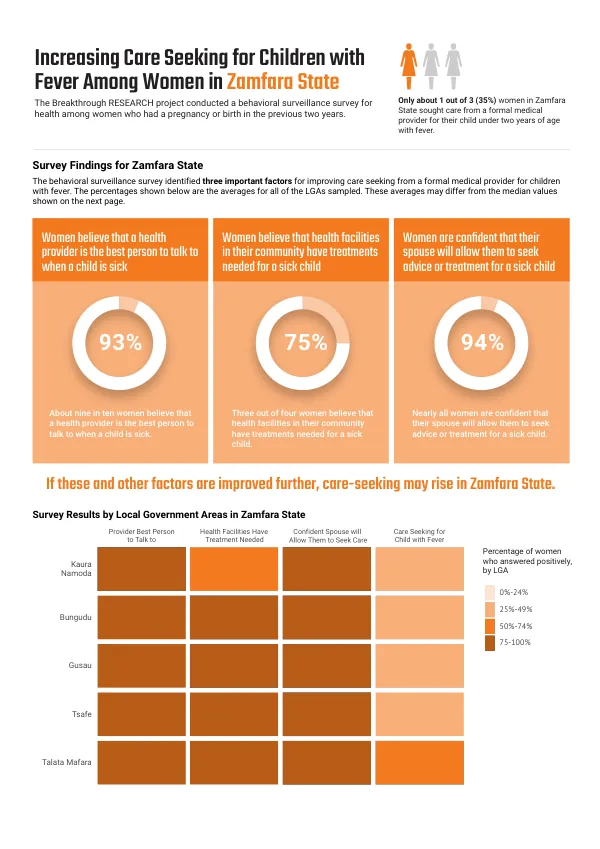
The Breakthrough RESEARCH project conducted a behavioral surveillance survey for health among women who had a pregnancy or birth in the previous two years in Zamfara State.
2021 · 2 pages
Sign in to readA free account is required to download.
Abstract
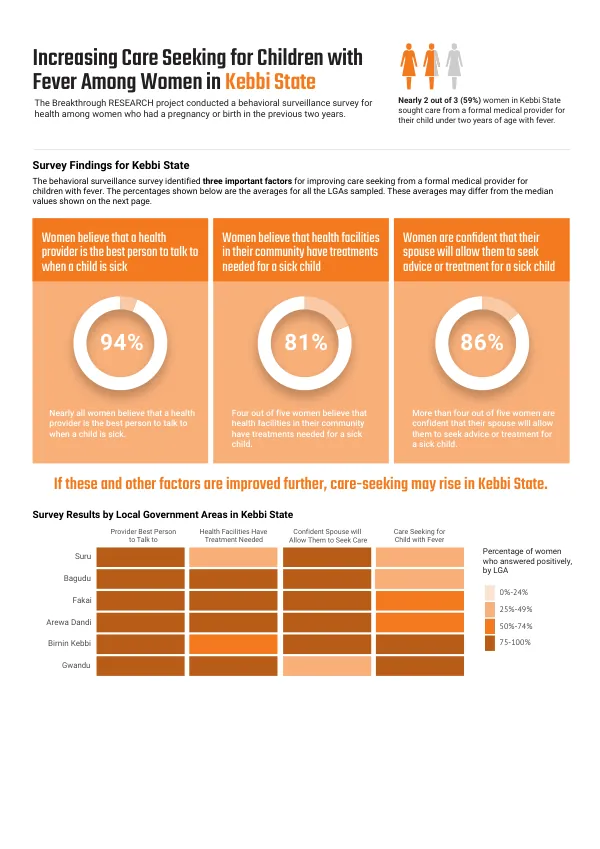
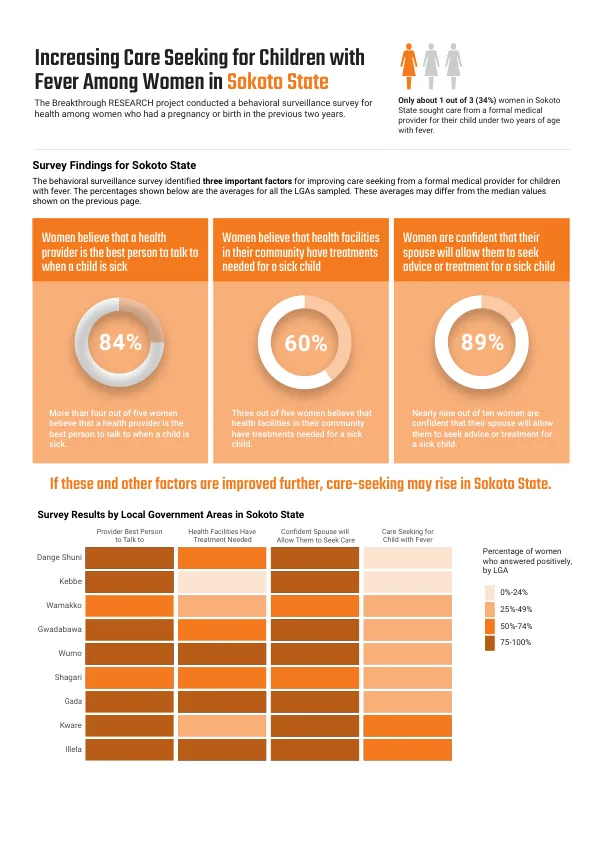
The survey aimed to identify factors that influence care seeking from a formal medical provider for children with fever. The results showed that nearly all women believe that a health provider is the best person to talk to when a child is sick, with 93% of women in Kaura, Namoda, Talata Mafara, Bungudu, Tsafi, and Gusau LGAs agreeing with this statement. Women's confidence in their spouse allowing them to seek advice or treatment for a sick child is also high, with 94% of women in these LGAs believing that their spouse will permit them to seek care. Additionally, nearly all women believe that health facilities in their community have treatments needed for a sick child, with 94% of women in these LGAs agreeing with this statement. The survey also found that women's perceptions of health facilities and their ability to provide necessary treatments vary across LGAs. In some LGAs, such as Gusau, nearly all women believe that health facilities have treatments needed for a sick child, while in other LGAs, such as Talata Mafara, fewer than 80% of women share this belief. The Breakthrough RESEARCH project's findings suggest that improving care seeking for children with fever in Zamfara State may require addressing the barriers that inhibit women from seeking formal medical care. These barriers may include a lack of confidence in health facilities, inadequate resources, and poor service delivery. On the other hand, LGAs with higher levels of care-seeking, such as Gusau, may have facilitators that increase women's ability to seek formal medical care, such as better-resourced and managed health facilities, and providers who give better client services and counseling. To improve care seeking for child fever in Zamfara State, the Breakthrough RESEARCH project recommends that community leaders and members address the barriers that inhibit women from seeking formal medical care. This may involve improving health facility resources and service delivery, as well as providing counseling and support to women. Additionally, the project suggests that efforts be made to reach communities and households in the greatest need of improving these factors related to care-seeking. The Breakthrough RESEARCH project is a USAID-funded program that aims to increase the practices of priority health behaviors for improved health and development outcomes. The project's findings and recommendations have the potential to inform policies and programs aimed at improving care seeking for children with fever in Zamfara State and beyond.