BREAKTHROUGH ACTION
Increasing Modern Contraceptive Use Among Women in Kebbi State
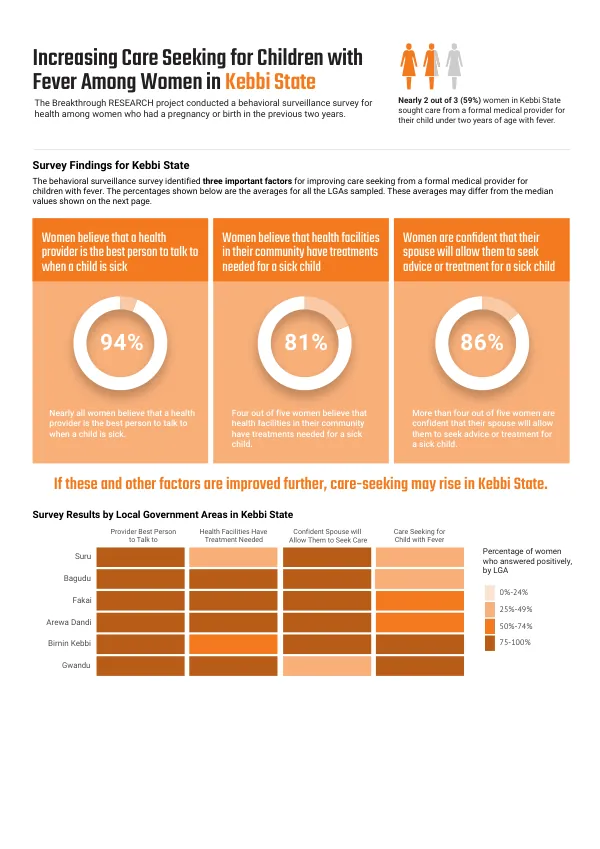
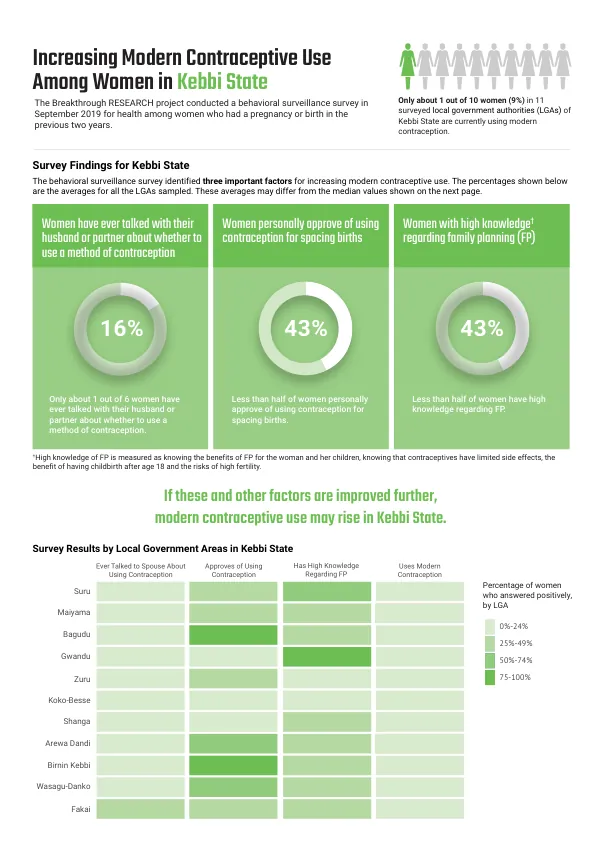
The Breakthrough RESEARCH project conducted a behavioral surveillance survey in September 2019 to assess health among women who had a pregnancy or birth in the previous two years in Kebbi State, Nigeria.
2021 · 2 pages
Sign in to readA free account is required to download.
Abstract
The survey aimed to identify factors influencing modern contraceptive use among women in the state. The results showed that only about 1 out of 10 women (9%) in 11 local government areas (LGAs) of Kebbi State are currently using modern contraception. The survey identified three key factors that can increase modern contraceptive use among women in Kebbi State. Firstly, women who have ever talked with their husband or partner about using a method of contraception are more likely to use modern contraception. Only about 1 out of 6 women (16%) have ever talked with their husband or partner about using a method of contraception. Secondly, women with high knowledge regarding family planning (FP) are more likely to use modern contraception. Less than half of women (43%) have high knowledge regarding FP, which is measured as knowing the benefits of FP for the woman and her children, knowing that contraceptives have limited side effects, the benefit of having childbirth after age 18, and the risks of high fertility. Thirdly, women who personally approve of using contraception for spacing births are more likely to use modern contraception. Less than half of women (43%) personally approve of using contraception for spacing births. The survey results also showed that there are variations in the levels of modern contraceptive use among the LGAs in Kebbi State. Some LGAs, such as Maiyama and Bagudu, have higher levels of modern contraceptive use, while others, such as Gwandu and Wasagu-Danko, have lower levels. The survey results also showed that women who have high knowledge regarding FP and who personally approve of using contraception for spacing births are more likely to use modern contraception. The findings of the survey suggest that improving the levels of modern contraceptive use in Kebbi State will require addressing the barriers that prevent women from using modern contraception. These barriers include limited knowledge regarding FP, lack of spousal communication, and lack of personal approval of using contraception for spacing births. The survey results also suggest that there are facilitators that can increase women's knowledge, approval, and agency for spousal communication and their ability to use modern contraception. These facilitators include strong leaders, ward development committees, and levels of community engagement in health issues. The survey results have implications for improving modern contraceptive use in Kebbi State. They suggest that efforts should be made to improve the levels of knowledge regarding FP among women, to increase spousal communication, and to increase personal approval of using contraception for spacing births. They also suggest that efforts should be made to identify and address the barriers that prevent women from using modern contraception. Additionally, they suggest that efforts should be made to identify and adopt the facilitators that increase women's knowledge, approval, and agency for spousal communication and their ability to use modern contraception.