CIMMYT
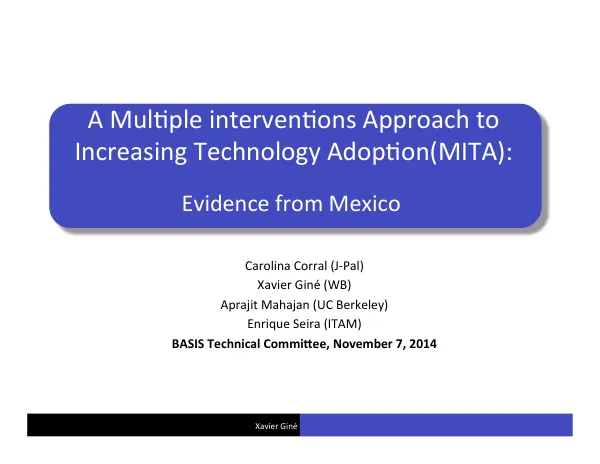
Increasing Technology Adoption (MITA): Evidence from Mexico
Increasing Technology Adoption (MITA) Approach: Evidence from Mexico The agricultural sector in Mexico has been experiencing low productivity levels, with yields averaging 44% below regional benchmarks.
2014 · 24 pages
Sign in to readA free account is required to download.
Abstract
Despite improvements since the 1980s, the country's agricultural productivity remains low, comparable to that of poorer countries. The main challenge lies among small landholders, who account for the majority of farmers in Mexico. The MITA initiative aims to address the underlying issues of heterogeneity and constraints affecting agricultural productivity. The program focuses on understanding the nature of the heterogeneity and constraints, as well as the effectiveness of interventions to address them. To achieve this, the MITA initiative employs a detailed measurement of land quality and inputs, including soil analysis and recommendations. The MITA approach involves several interventions, including improved information, relaxing credit constraints, and facilitating market access. The program also focuses on providing training to farmers, improving soil analysis, and promoting the use of best practices. The initiative has been implemented in various regions, including Tlaxcala, where 430 farmers were randomly selected to participate in the program. The MITA initiative has been successful in improving agricultural productivity, with a 27% increase in yields among program participants compared to the control group. The program has also improved farmers' income, with a 15% increase in income among program participants. The MITA approach has been effective in addressing the underlying issues of heterogeneity and constraints affecting agricultural productivity in Mexico. The MITA initiative has also improved farmers' knowledge and skills, with a significant increase in the adoption of best practices and improved soil analysis. The program has also improved farmers' access to credit and markets, enabling them to increase their productivity and income. The MITA approach has been successful in improving agricultural productivity and farmers' income in Mexico, and it has the potential to be replicated in other regions. The MITA initiative has also improved the quality of agricultural extension services, with a significant increase in the number of extension agents trained in crop sciences. The program has also improved the quality of agricultural extension services, with a significant increase in the number of farmers trained in conservation agriculture protocols. The MITA approach has been successful in improving agricultural productivity and farmers' income in Mexico, and it has the potential to be replicated in other regions.