BOOZ, ALLEN AND HAMILTON, INC.
Increasing the Hourly Wage for Overtime Hours Worked
The regulation Increasing the Hourly Wage for Overtime Hours Worked requires all employers to pay time-and-a-half the standard wage rate to workers for hours worked in excess of 40 hours per week.
2013 · 2 pages
Sign in to readA free account is required to download.
Abstract
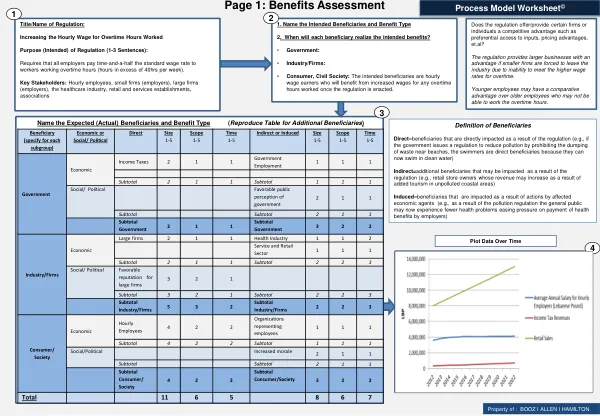
This regulation aims to improve the working conditions and compensation of hourly wage earners. The intended beneficiaries of this regulation are hourly wage earners who will benefit from increased wages for overtime hours worked. The regulation is expected to have a positive impact on hourly employees, with a 4 out of 5 rating for economic benefits and a 2 out of 5 rating for social/political benefits. The benefits are expected to be realized immediately upon the regulation's enactment. The regulation is also expected to have a positive impact on organizations representing employees, with a 1 out of 5 rating for economic benefits and a 1 out of 5 rating for social/political benefits. In contrast, the regulation is expected to have a negative impact on small firms, with a 1 out of 5 rating for economic benefits and a 1 out of 5 rating for social/political benefits. The regulation may force small firms to leave the industry due to their inability to meet the higher wage rates for overtime. Younger employees may have a comparative advantage over older employees who may not be able to work overtime hours. The intended cost bearers of the regulation are all employers whose labor costs would increase for overtime hours. The costs are expected to be borne by large firms, which may be able to avoid the costs by hiring additional labor to work 40 hours per week rather than paying existing employees to work overtime. Large firms that gain market share and additional market power as a result of smaller firms leaving the industry may be able to increase their prices while maintaining the level of demand for their produced goods, shifting the added costs of overtime wages to consumers. The regulation is expected to have a negative impact on the government, with a 2 out of 5 rating for economic benefits and a 1 out of 5 rating for social/political benefits. The regulation may require additional resources and staffing to monitor and enforce the regulation. The government may also experience a negative impact on small firm-public perception of government. The regulation is expected to have a positive impact on industry/firms, with a 5 out of 5 rating for economic benefits and a 3 out of 5 rating for social/political benefits. The regulation may lead to increased insurance costs for firms that offer overtime, but may also lead to increased market share and additional market power for large firms. The regulation may also lead to increased healthcare costs for healthcare providers. The regulation is expected to have a negative impact on consumer/society, with a 2 out of 5 rating for economic benefits and a 1 out of 5 rating for social/political benefits. The regulation may lead to increased costs for overtime workers, including less leisure time and increased stress. The final RIA assessment indicates that the total benefits of the regulation are $43, while the total costs are $42, resulting in a benefit-to-cost ratio of 1.02. This suggests that the regulation is expected to have a net benefit, but the costs and benefits are closely balanced.