USAID DEC
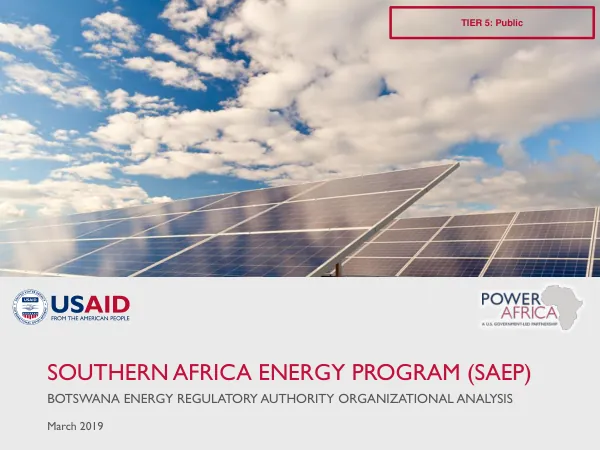
Southern Africa Energy Program (SAEP) Botswana Energy Regulatory Authority Organizational Analysis
Sign inUSAID DEC
Southern Africa Energy Program (SAEP) Botswana Energy Regulatory Authority Organizational Analysis
The Southern Africa Energy Program (SAEP) Botswana Energy Regulatory Authority Organizational Analysis was conducted in March 2019.
2019 · 24 pages
Sign in to readA free account is required to download.
Abstract
The analysis aimed to evaluate the responsibilities and structure of the Botswana Energy Regulatory Authority (BERA) to determine if it is organized properly to carry out its mandate. The SAEP mandate is to enhance the capacity of regulatory authorities throughout the SADC region. The SAEP approach involved an inception phase, which included gathering input from BERA's board members to reach a shared vision for the organization. The board members were asked to identify what they envisioned for BERA, what was preventing the organization from attaining that vision, and what needed to be done to remove those impediments. The output from this phase was a scope of work that outlined the tasks to be undertaken in the analysis. The SAEP analytical approach involved a review of BERA's Act and mandate, as well as other materials bearing on the subject. This included engagement with the ministry and other stakeholders, consideration of leading regulatory practices, and evaluation of alternative mechanisms to carry out BERA's mandate. The analysis also involved a review of the BERA Act and mandate, which outlined the organization's legal mandate, roles and objectives, independence, accountability, transparency, participation, predictability, and accessibility. The review of the BERA Act and mandate identified several key areas for consideration, including the establishment of BERA by legislation, the clarity of its roles and objectives, its independence, measures to ensure accountability, transparency of its practices and procedures, participation in decision-making, and the bounds of regulatory discretion. The analysis also considered the structure that best supports BERA in fulfilling its mandate. In addition to the review of the BERA Act and mandate, the analysis considered other materials informing the subject, including previous reports, leading practices regulatory literature, other regulatory authorities in the SADC region, and leading practices corporate governance literature. Stakeholder engagement was also a key component of the analysis, with input sought from BERA's board members, the ministry, BERA management and staff, and other relevant stakeholders. The consideration of leading regulatory practices involved an examination of governance, substance, and outcome. The analysis aimed to identify best practices in these areas and assess how they could be applied to BERA to enhance its effectiveness and efficiency. The evaluation of alternative mechanisms to carry out BERA's mandate involved an assessment of different options for achieving the organization's objectives, including the use of new technologies, changes to its structure, and the development of new policies and procedures. The SAEP analysis aimed to provide recommendations for improving BERA's organizational structure and practices to enhance its effectiveness and efficiency in fulfilling its mandate. The analysis was conducted in accordance with leading regulatory practices and involved a comprehensive review of BERA's Act and mandate, as well as engagement with stakeholders and consideration of alternative mechanisms to carry out its mandate.