USAID DEC
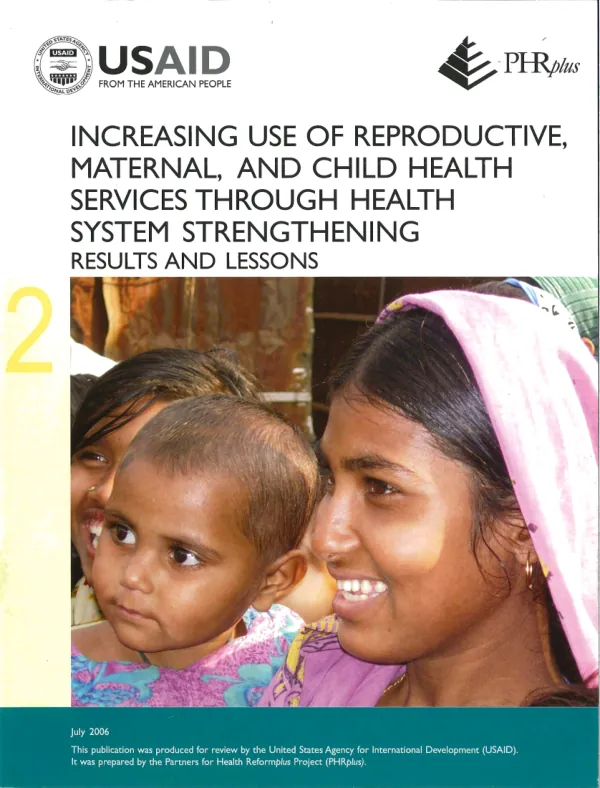
Increasing Use of Reproductive, Maternal, and Child Health Services Through Health System Strengthening: Results and Lessons
Sign inABT ASSOCIATES
Increasing Use of Reproductive, Maternal, and Child Health Services Through Health System Strengthening: Results and Lessons
Health system strengthening (HSS) is a critical component of improving priority services, particularly in the areas of reproductive, maternal, and child health.
2016 · 44 pages
Sign in to readA free account is required to download.
Abstract
HSS encompasses an array of initiatives and strategies aimed at improving the functioning of a health system or any of its sub-parts. These initiatives and strategies aim to improve access, quality, equity, efficiency, and sustainability of health services. The World Health Organization defines health systems as "all the organizations, institutions and resources that are devoted to producing health actions." A health system encompasses health policies and programs, laws and regulations, organization and management structures, and financing arrangements, which in combination result in availability and quality of services aimed at improving health. A health system includes all levels of a country's health care system: central, regional, district, community, and household. It also includes public and private participation in financing, risk sharing, and provision of services. Strong health systems are critical to achieving better health outcomes, and HSS complements program-specific efforts to ensure the delivery of priority services and achieve equitable and sustainable health outcomes. Priority services, such as reproductive health, maternal health, and child health, rely on health systems to function effectively. In the context of reproductive health, HSS initiatives have been implemented in various countries to improve access to family planning services. For example, in Albania, a project aimed to improve service quality by increasing the availability of contraceptive methods and improving the skills of healthcare providers. In the Philippines, a national health insurance program was implemented to promote access to family planning services. In the area of maternal health, HSS initiatives have focused on improving the quality of maternal health services. In Mali, a project aimed to increase the use of maternal health services through mutual health organizations. In Yemen, a Midwives Association was established to improve the quality of maternal health services. In Jordan, a project aimed to improve the continuity of maternal care by strengthening the referral system. In the area of child health, HSS initiatives have focused on improving access to preventive child health services. In Mali and Senegal, a project aimed to increase the use of preventive child health services through membership in mutual health organizations. In Jordan, a public health insurance program was expanded to cover children. In Uganda, sustained financing was secured for child immunizations. Overall, HSS is essential to improving priority services, particularly in the areas of reproductive, maternal, and child health. By strengthening health systems, countries can improve access, quality, equity, efficiency, and sustainability of health services, ultimately leading to better health outcomes.