INTERNATIONAL LIVESTOCK RESEARCH INSTITUTE
Index Based Livestock Insurance for Pastoralists in Ethiopia
The agricultural development initiative in the Borana plateau in southern Ethiopia focuses on improving the livelihoods of pastoralist households.
2013 · 2 pages
Sign in to readA free account is required to download.
Abstract
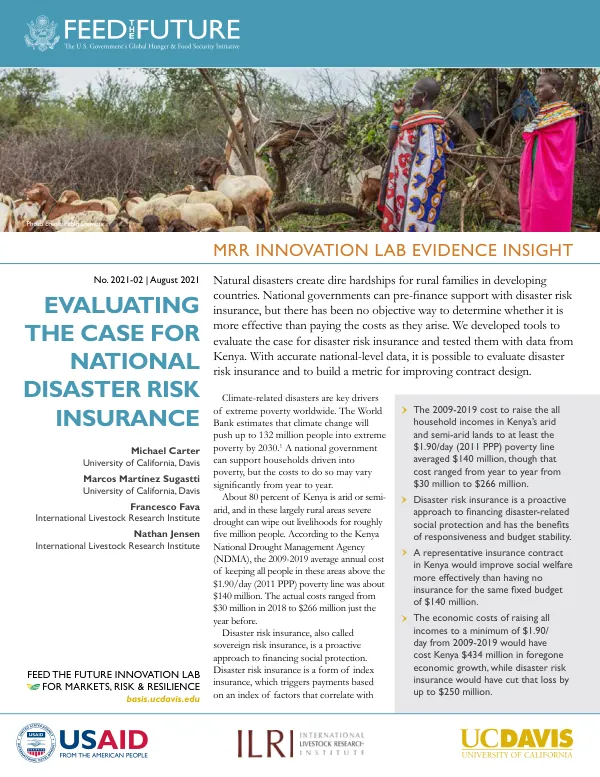
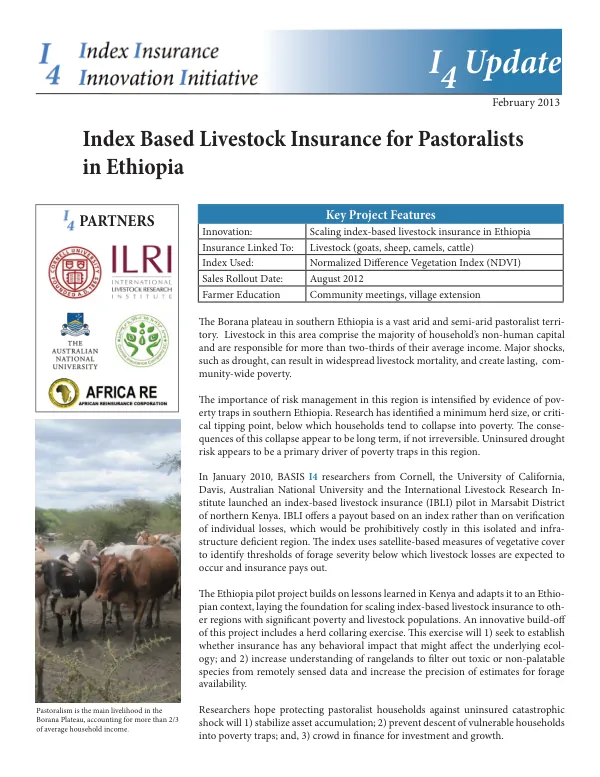
Pastoralism is the primary livelihood in the region, accounting for more than 2/3 of average household income. Livestock in this area comprise the majority of household non-human capital and are responsible for more than two-thirds of their average income. However, significant shocks, such as drought, can result in widespread livestock mortality and create lasting, community-wide poverty. Research has identified poverty traps in the region, with a critical herd size below which households tend to fall into poverty. The consequences of this collapse appear to be long-term and potentially irreversible. Uninsured drought risk is a primary driver of poverty in this region. To address this issue, an innovative approach is being implemented, focusing on index-based livestock insurance (IBLI). The IBLI pilot in Marsabit, Kenya, serves as a model for scaling index-based livestock insurance to other regions with significant poverty and livestock populations. The project builds on lessons learned in Kenya and adapts the approach to an Ethiopian context. The IBLI team uses satellite-based measures of vegetative cover to determine thresholds of forage severity, below which livestock losses are expected to occur, and pays out insurance claims accordingly. The project aims to stabilize asset accumulation, prevent descent of households into poverty, and increase understanding of rangeland ecology. The IBLI team is working with OIC, the Oromia Insurance Company, to implement the product in Ethiopia. Despite initial challenges, the team is optimistic about the potential for scaling up the product in the region. A key component of selling livestock insurance in Ethiopia is educating potential clients about the IBLI concept and the benefits of the product. The IBLI team has invited clients from the Marsabit region in northern Kenya, who received an insurance payout from the October 2011 drought, to share their experiences with potential clients in Ethiopia. This approach aims to increase understanding and trust in the insurance product, ultimately leading to increased adoption and improved livelihoods for pastoralist households.
Related documents