USAID DEC
Industry Report: Supply Chain Relationship Quality Outlook of Women-Owned Agri businesses in Ghana
Sign inUSAID DEC
Industry Report: Supply Chain Relationship Quality Outlook of Women-Owned Agri businesses in Ghana
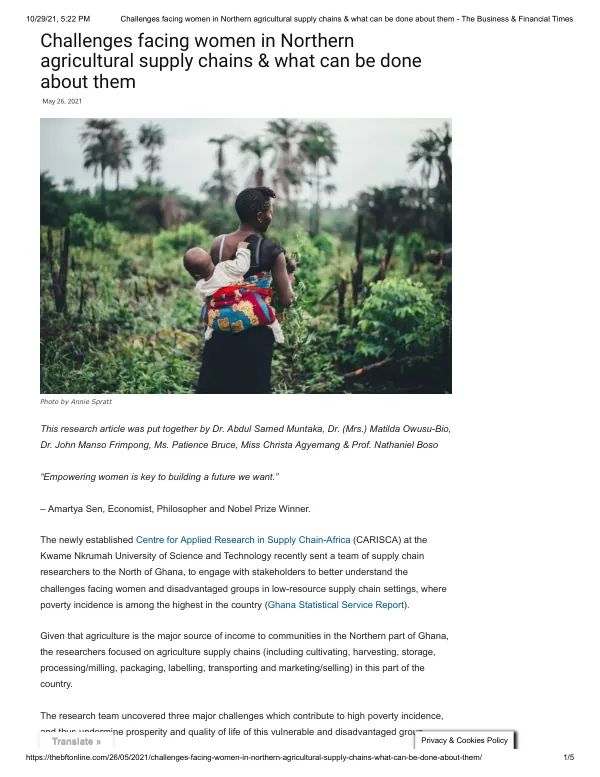
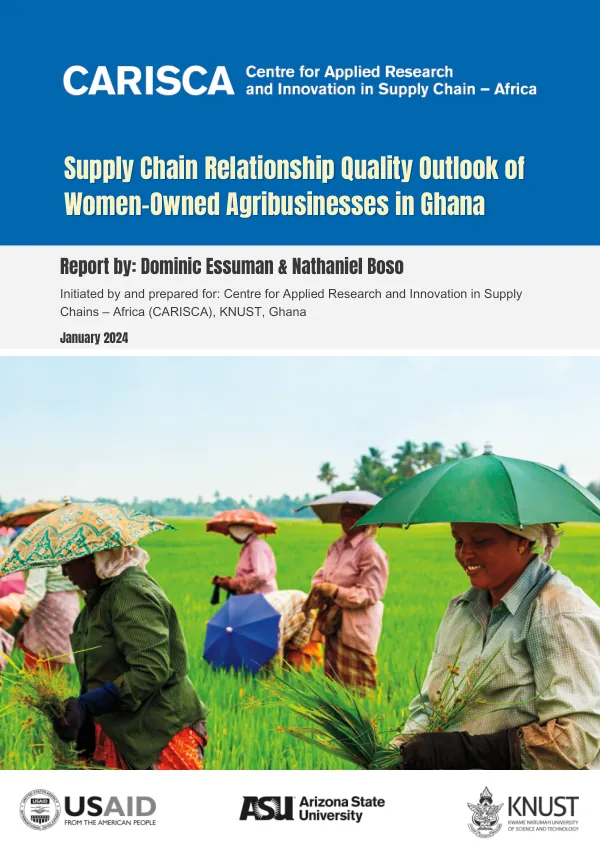
Women-owned businesses (WOBs) in Ghana's agricultural sector face significant institutional, economic, and managerial hurdles in their supply chains, making them vulnerable actors.
2024 · 50 pages
Sign in to readA free account is required to download.
Abstract
These challenges can impair WOBs' ability to nurture and sustain supply chain relationship quality. However, policy interventions for WOBs are lacking, and the framers and implementers of such interventions do not have empirical knowledge to guide them. This research provides initial empirical evidence on the relationship quality outlook for WOBs' supply chains in a segment of Ghana's agricultural sector. The study used varied sets of conceptual frames and indicators to capture supply chain relationship quality from the perspective of 300 women entrepreneurs in agricultural supply chains in the Ashanti region of Ghana. The results suggest that both the supplier and customer network portions of the WOBs' supply chains have a satisfactory level of supply chain relationship quality. Specifically, the supply chains of these businesses generally exhibit moderate levels of relationship strength, including long-term relationship orientation, commitment, collaboration, coordination, and information sharing. Additionally, relationship well-being, including satisfaction and happiness, is also moderate. However, dysfunctional relationship issues, such as complaints, conflicts, tension, cheating, dishonesty, and bondage, are lower across multiple supply chain scenarios. Supply chain relationship quality differs in magnitude across supply and customer relationships and relationships involving larger and smaller actors in supply and customer markets. Relationship strength complements relationship well-being, but both are lower in supply chains that report greater levels of dysfunctional relationship issues. Furthermore, the study's results suggest that high relationship strength factors or low dysfunctional relationship factors might be insufficient for WOBs to enhance relationship well-being in their supply chains. The research report discusses the implications of the above results for policymakers, including broadening the scope of institutional support projects for WOBs to incorporate supply chain relationship development, resourcing WOBs in designing and implementing supply chain governance mechanisms, creating and sustaining effective and efficient legal systems to drive supply chain governance mechanisms and relationship quality, increasing WOBs' access to handy information and communication technologies to foster supply chain relationship quality, and instituting measures that allow WOBs to generate superior economic rents from supply chain relationship quality. The study's findings have significant policy and practical implications for WOBs in Ghana's agricultural sector. Policymakers and funders can use the results to inform the development of targeted interventions aimed at improving supply chain relationship quality for WOBs. By addressing the institutional, economic, and managerial hurdles faced by WOBs, policymakers can help these businesses to build stronger relationships with their suppliers and customers, ultimately leading to improved supply chain performance and economic outcomes.