CAROLINA POPULATION CENTER AT THE UNIVERSITY OF NORTH CAROLINA AT CHAPEL HILL
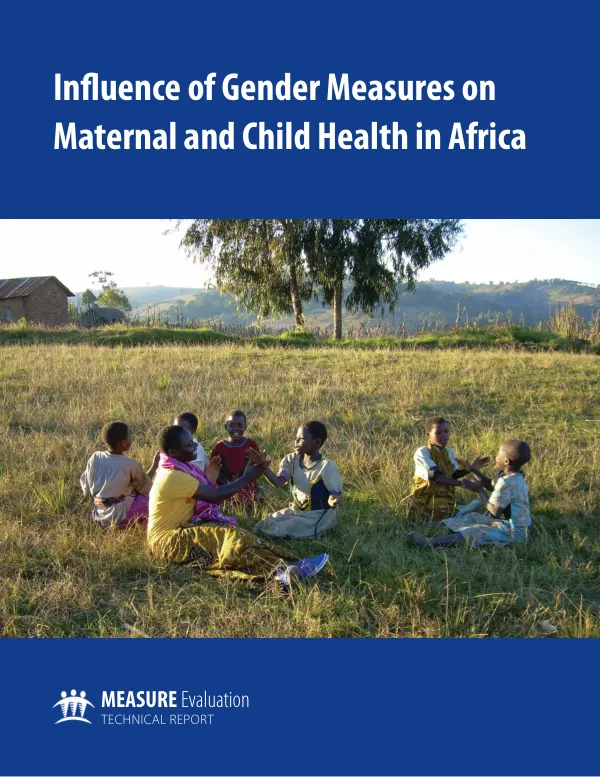
Influence of Gender Measures on Maternal and Child Health in Africa
The Millennium Development Goals (MDGs) recognize the interdependence of gender issues, maternal and child health, poverty reduction, and developmental progress.
2011 · 66 pages
Sign in to readA free account is required to download.
Abstract
Despite progress, maternal mortality remains high in developing countries, with the World Health Organization (WHO) estimating 358,000 maternal deaths in 2008. The Institute of Health Metrics and Evaluation had a similar estimate at 342,900. Millennium Development Goal (MDG) 5a aims to reduce by 2/3 the maternal mortality ratio (MMR) from 1990 to 2015. However, the decrease from 542,424 deaths in 1990 to WHO's estimate of 358,000 in 2008 represents only a 34% decline. Africa accounts for 58% of maternal deaths and 51% of under-five deaths, despite accounting for only 15% of the world's population. Research has demonstrated a clear positive relationship between gender measures and a woman's ability to seek and advocate for services for both herself and her children. However, only a handful of studies have focused on African women. This report explores associations between gender measures and four health outcomes, including low Body Mass Index (BMI), an indicator of overall maternal health; birth in a facility, an indicator of the utilization of maternal health services and a proxy measure for maternal mortality; having a child who is fully immunized, an indicator of the utilization of a preventive child health service; and treatment-seeking for a child with an acute respiratory infection (ARI), an indicator of the utilization of a curative child health service. The report examines a diverse set of eight African countries for which recent Demographic and Health Survey (DHS) data were available: Democratic Republic of the Congo (DRC), Egypt, Ghana, Liberia, Mali, Nigeria, Uganda, and Zambia. Studies examining the relationship between gender inequality and health have consistently found that gender-related factors have an effect on health outcomes that is independent of education, economic status, religion, and other social factors. Simplified measures of gender equality capture aspects of behavior or attitudes and are now part of survey mechanisms such as the DHS. These measures are based on combining a few items to measure constructs such as household decision-making and access to economic resources. The report focuses on areas of gender equality known to affect health outcomes for women and children, which are available in the DHS data. Specifically, the report examines women's autonomy within the context of household and financial decision-making and social norms regarding attitudes towards wife beating and refusing sex. Several socioeconomic variables are also examined, including age, parity, residence (urban/rural), education level, wealth quintile, and working status. Age and gender of the index child are also included in models of child health service utilization. A series of multivariate logistic regressions were used to study the effect of the gender equity measures on the health outcomes, controlling for the socioeconomic variables. The strongest associations were between the outcome variables involving access to health facilities (facility delivery, full immunization, and treatment for acute ARI) and the predictor variables education and wealth, both factors associated with a much higher likelihood of access. Key findings were that in five of eight countries examined, household and financial decision-making authority were significantly associated with women's general health as measured by low BMI. Decision-making authority and attitudes towards gender roles were significantly associated with facility delivery in Nigeria, and attitudes towards gender roles were significantly associated with facility delivery in both Ghana and Uganda. The only gender equity measures significantly associated with a child being fully immunized were the household decision-making and wife beating never acceptable variables in Nigeria. Gender equity measures were not significantly associated with treatment for an ARI except in the DRC (where high decision-making authority was protective) and Zambia (where belief that a wife does not have a right to refuse sex was associated with lower likelihood of treatment). However, sample sizes for treatment for an ARI were relatively small and are a limitation of the analysis. That gender equity measures were significant in some countries even after controlling for education and wealth suggests that programs and policy should facilitate empowerment in addition to focusing on educating girls and reducing poverty. Since low BMI is often a sign of chronic energy deficiency (CED), women who are consistently able to make decisions and have a financial say may be in a better position to take care of themselves. It could be that gender measures have more influence on overall health than on access to services at certain points in time. Recommendations from this report would be for programs and policies to continue focusing on education and poverty reduction and increasing access to services. In addition, programs focused on gender measures can have benefits that go beyond programs focused only on education and poverty reduction. In the countries studied, gender measures were particularly important for a woman's own health. Countless studies have shown the influence of a woman's health on her pregnancy, birth outcomes, and children's health. Findings from this report provide clear evidence of the importance of promoting gender equity as a means to improve both maternal and child health in Africa and as a means to help countries achieve their MDGs.