FOOD AND AGRICULTURE ORGANIZATION OF THE UNITED NATIONS IN GEORGIA
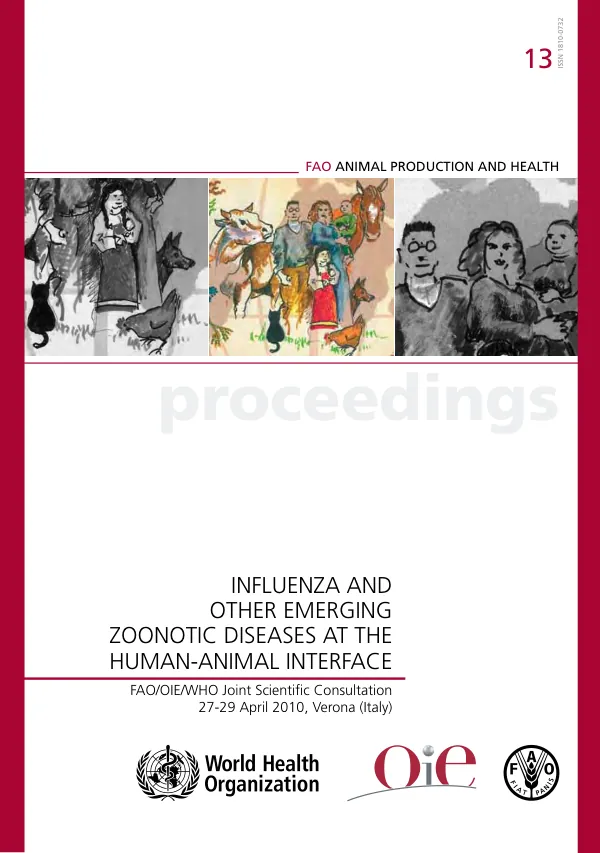
Influenza and other emerging zoonotic diseases at the human-animal interface
The Joint Scientific Consultation on Influenza and other Emerging Zoonotic Diseases at the Human-Animal Interface was held from 27 to 29 April 2010, in Verona, Italy.
2011 · 66 pages
Sign in to readA free account is required to download.
Abstract
The meeting was organized by the Food and Agriculture Organization of the United Nations (FAO), the World Organisation for Animal Health (OIE), and the World Health Organization (WHO). The consultation aimed to identify commonalities among diseases and provide a scientific basis for collaborative, multisectoral actions. The meeting built on previous international policy and technical meetings, including the International Ministerial Conference on Animal and Pandemic Influenza (IMCAPI) meetings and the "One Health" meetings held in Winnipeg, Canada, and Stone Mountain, United States of America. Initially, the focus was on pandemic and avian influenza, but the perspective has evolved to include broader thinking on other influenza subtypes and emerging zoonoses. The consultation considered not only influenza but also other emerging viral zoonoses, and it attempted to identify the commonalities among diseases. It was agreed that important lessons learned through recent experiences with zoonotic influenza emergence can be applied to other emerging zoonoses. However, gaps remain in the global understanding of influenza, including the association between molecular structure and epidemiologic and clinical characteristics, and the impacts of ecological and other contextual aspects. The consultation emphasized the need for a multisectoral approach to address disease emergence at the human-animal interface. It was agreed that future data collection for any disease must aim to include a wider range of contextual information and that these data must be factored into subsequent analyses. Modelling can be useful for understanding and even predicting some diseases, as long as sufficient appropriate data are available. The consultation identified eight priority areas for action, including data sharing and improved surveillance. Data sharing was discussed as a means of making more data accessible and accessible to a wider group, by breaking down the concept of data ownership and reducing technical, legal, and political/conceptual barriers to data sharing. More tangible and equitable incentives, rewards, and benefits for contributing, using, and analyzing data appropriately, and technical solutions for improving data interchange would facilitate wider and more effective sharing. Surveillance was identified as a long-standing challenge owing to its complexity. Building capacity for surveillance of known diseases is critical in enabling the detection of unusual events, and overall efficiency may be increased by using syndromic, participatory, or targeted approaches. New and innovative strategies, such as using social networking systems and engaging non-traditional partners, were recognized as opportunities for improving surveillance, especially in under-resourced settings. Routine inclusion of ecosystem aspects that may underlie or facilitate disease emergence, including changes in land-use practices, agricultural impacts on ecosystems, natural resource extraction, wildlife trade, and production systems, was identified as a priority for addressing disease emergence at the human-animal interface. The development of diagnostics for the early, field-based detection of emerging diseases is another long-standing challenge, especially in the identification and characterization of new or evolving pathogens. New technologies are evolving, and finding ways to achieve laboratory sustainability, to identify feasible and appropriate methods for specimen transport and collection, and to link data to specimens is essential. The consultation also emphasized the need for behaviour change and communication to reduce disease emergence. This includes promoting behavioural change to reduce disease emergence and improving communication among stakeholders, including the public, healthcare providers, and animal health professionals. Capacity building, education, and research were identified as essential for addressing disease emergence at the human-animal interface. This includes building capacity for surveillance, diagnostics, and research, as well as promoting education and training for stakeholders. A multidisciplinary collaborative approach was recognized as essential for addressing disease emergence at the human-animal interface. This includes collaboration among stakeholders, including the public, healthcare providers, animal health professionals, and policymakers. Sustainable approaches were identified as essential for addressing disease emergence at the human-animal interface. This includes promoting sustainable agriculture practices, reducing the impact of human activities on ecosystems, and promoting the conservation of biodiversity. The consultation concluded that addressing disease emergence at the human-animal interface requires a comprehensive and multisectoral approach. This includes addressing the root causes of disease emergence, improving surveillance and diagnostics, promoting behaviour change and communication, building capacity, and promoting sustainable approaches.