CARE
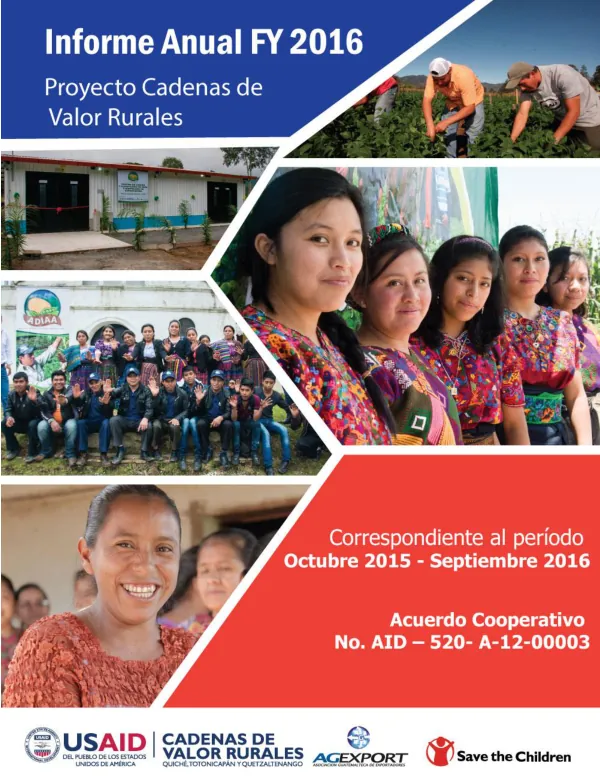
Informe Anual de octubre 2015 a septiembre 2016: Proyecto Cadenas de Valor Rurales
The agricultural development project in Guatemala, known as the Cadenas de Valor Rurales (RVCP), began in 2012 with funding from USAID.
2016 · 73 pages
Sign in to readA free account is required to download.
Abstract
The project aimed to expand the participation of rural families in selected value chains to increase their incomes. The project focused on the departments of Quiché, Totonicapán, and Quetzaltenango, with a focus on the sectors of horticulture, coffee, and handicrafts. The project was implemented by a consortium led by the Asociación Guatemalteca de Exportadores (AGEXPORT). The project's budget was $20 million, and it was expected to be completed in May 2017. The project aimed to provide technical assistance and business development services to small and medium-sized enterprises (MIPYMES) in the target areas. The project reported significant results in the period from October 2015 to September 2016. The total number of families assisted was 18,004, organized into 170 MIPYMES. The MIPYMES were involved in various activities, including the production of horticultural products, coffee, cardamomo, and handicrafts. The project reported significant sales, exceeding the target of $24,634,254 by 19%. The total sales for the period were $29,375,203. The sales were generated from the sale of various products, including horticultural products, coffee, cardamomo, and handicrafts. The project also reported the creation of 2,390,700 jobs, equivalent to 9,195 jobs, exceeding the target of 1,400,000. The project also reported the implementation of various initiatives aimed at improving the security of food and nutrition (SAN). The project collaborated with various organizations, including MASFRIJOL, NUTRISALUD, BUENA MILPA, and CLUSA, to train over 13,000 families in various topics related to food security and nutrition. The project also reported the coordination of actions with the Asociación del Gremio Químico Agrícola (AGREQUIMA), which allowed for the collection of empty containers in the communities influenced by the business enclosures supported by the RVCP. Additionally, the project coordinated the training of RVCP technicians in integrated pest and disease management with the United States Department of Agriculture (USDA). The project also participated in spaces for policy influence, achieving the establishment of a roadmap for SAN coordination between the Ministry of Agriculture and Livestock (MAGA) and the Ministry of Food Security and Nutrition (SESAN) in the context of the new government.