USAID DEC
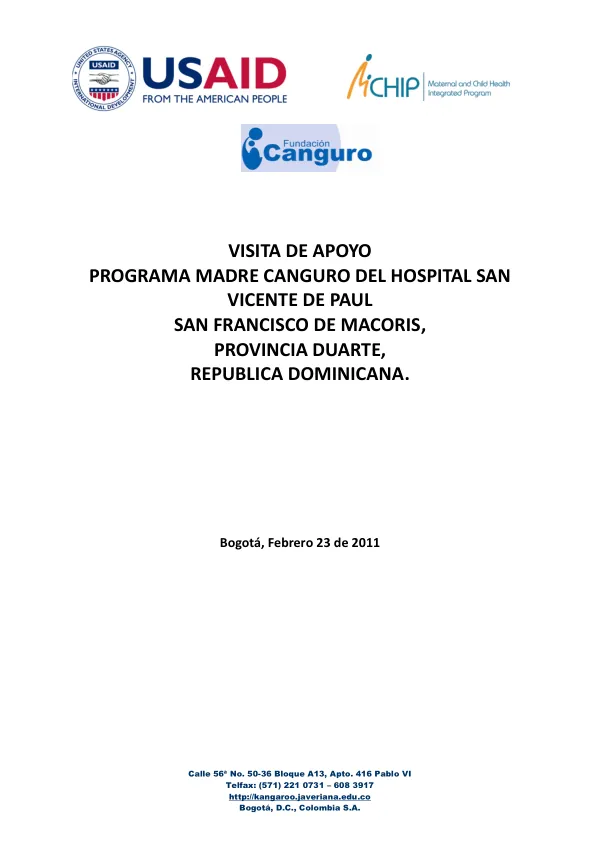
Informe de seguimiento a la adecuada implementación del Programa Madre Canguro del Hospital San Vicente de Paul
Sign inUSAID DEC
Informe de seguimiento a la adecuada implementación del Programa Madre Canguro del Hospital San Vicente de Paul
The Hospital San Vicente de Paul in San Francisco de Macoris, Provincia Duarte, Republica Dominicana, implemented the Madre Canguro (Mother Kangaroo) program in May 2009.
2014 · 40 pages
Sign in to readA free account is required to download.
Abstract
The program aimed to provide care to premature and low-birth-weight infants. The hospital received training in the Madre Canguro Method (MMC) from a team of professionals from the Fundación Canguro in Bogotá, Colombia. The hospital's neonatology unit was renovated and equipped with comfortable chairs and skin-to-skin contact devices for mothers. However, the unit still lacks sufficient professionals, particularly during evening and night shifts. The hospital's staff is convinced of the benefits of the Madre Canguro program and has been sensitized to its implementation. The hospital has trained three other centers in the Madre Canguro program, and a diploma was awarded to the Hospital San Vicente de Paul as a certified center for premature care and training. The hospital is considering organizing a national kangaroo meeting to discuss the creation of a package that would ensure the sustainability of the Madre Canguro program in the Republic of Dominican. The Madre Canguro program implemented at the hospital provides care to premature and low-birth-weight infants from birth to 12 months of age. The program includes intrahospital and ambulatory care, with a focus on skin-to-skin contact and breastfeeding. The hospital has achieved significant results in reducing mortality rates and improving the health outcomes of premature and low-birth-weight infants. The hospital's Madre Canguro program has been evaluated, and the results show that the program is effective in reducing mortality rates and improving the health outcomes of premature and low-birth-weight infants. The program has also been recognized as a model for other hospitals in the region. The hospital's staff is committed to continuing the program and improving its implementation to ensure the best possible outcomes for premature and low-birth-weight infants. The hospital's Madre Canguro program has been recognized as a best practice in the region, and it has been replicated in other hospitals. The program's success is attributed to the hospital's commitment to providing high-quality care to premature and low-birth-weight infants. The program's implementation has also been supported by the Fundación Canguro, which has provided training and technical assistance to the hospital's staff. The hospital's Madre Canguro program has improved the health outcomes of premature and low-birth-weight infants in the region. The program's success has also been recognized by the Ministry of Health, which has provided support and recognition to the hospital for its efforts in improving the health outcomes of premature and low-birth-weight infants. The hospital's Madre Canguro program is a model for other hospitals in the region, and it has the potential to improve the health outcomes of premature and low-birth-weight infants in the region.