USAID DEC
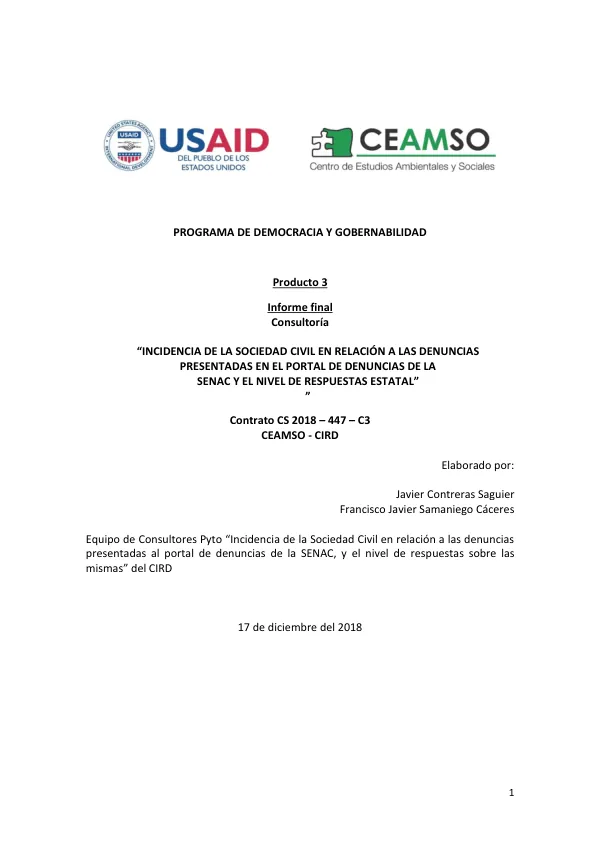
Informe final: Incidencia de la Sociedad Civil en relación a las denuncias presentadas en el portal de denuncias de la SENAC y el nivel de respuestas estatal
Sign inCENTRO DE ESTUDIOS AMBIENTALES Y SOCIALES
Informe final: Incidencia de la Sociedad Civil en relación a las denuncias presentadas en el portal de denuncias de la SENAC y el nivel de respuestas estatal
The Programa de Democracia y Gobernabilidad (PDG) is a program implemented by the Centro de Estudios Ambientales y Sociales (CEAMSO) with the objective of improving the effectiveness of the Paraguayan government in developing its institutional and human resources capacity, as well as consolidating mechanisms for transparency and accountability.
2018 · 152 pages
Sign in to readA free account is required to download.
Abstract
The program aims to establish a clear path towards a greater capacity to respond to citizen needs and demands, and a more solid foundation for democracy and the rule of law. The PDG focuses on strengthening internal control and administration systems in key public institutions, prioritizing functions such as civil service, public finance management, and audit and control instances. The program has four strategic objectives: improving institutional capacity in public institutions, strengthening accountability, transparency, and anti-corruption actions, improving the legal framework and public policies to enhance state effectiveness, and strengthening CEAMSO as a sustainable and leading Paraguayan civil society organization. The PDG has also established transversal components, including communication, monitoring and evaluation, gender equity, and information and communication technology (ICT). The program has supported the development and implementation of the portal de denuncias anticorrupción (anticorruption denunciation portal) of the Secretaria Nacional Anticorrupción (SENAC), which receives denunciations of corruption made by citizens and has a system for managing these denunciations. The consultoría (consultancy) was conducted to promote transparency and accountability within the Paraguayan government, specifically within the SENAC, regarding data related to the fight against corruption. The consultancy aimed to accompany the SENAC in the process of collecting and monitoring data from the portal de denuncias, as well as supporting the analysis of the data to determine the impact of the portal and the Sistema de Seguimiento de Procesos (SSPS) on the fight against corruption. The consultancy was justified by the importance of detecting, denouncing, investigating, clarifying, and sanctioning cases of corruption. The SENAC's role in facilitating the presentation of denunciations and directing them to the competent entities for investigation and prosecution is crucial in preventing corruption. The consultancy aimed to promote transparency and accountability in the process, allowing the society to know that the state is taking measures against corruption. The consultancy involved the collection and analysis of data from the portal de denuncias, as well as the monitoring of cases generated as a result of the denunciations. The data was provided by various institutions, including the Ministerio de Educación y Ciencias, the Ministerio de Salud Pública y Bienestar Social, the Policía Nacional, the Instituto de Previsión Social, the Ministerio de Obras Pública y Bienestar Social, the ANDE, the Ministerio de Defensa Nacional, the INTN, the Ministerio de Hacienda, and the Ministerio del Ambiente y Desarrollo Sostenible. The consultancy concluded that the SENAC's portal de denuncias and the SSPS have had a positive impact on the fight against corruption, with a significant increase in the number of denunciations and a higher level of transparency and accountability in the process. The consultancy recommended that the SENAC continue to improve its mechanisms for collecting and analyzing data, as well as its communication and monitoring efforts, to ensure the effectiveness of the portal and the SSPS in preventing corruption.