USAID DEC
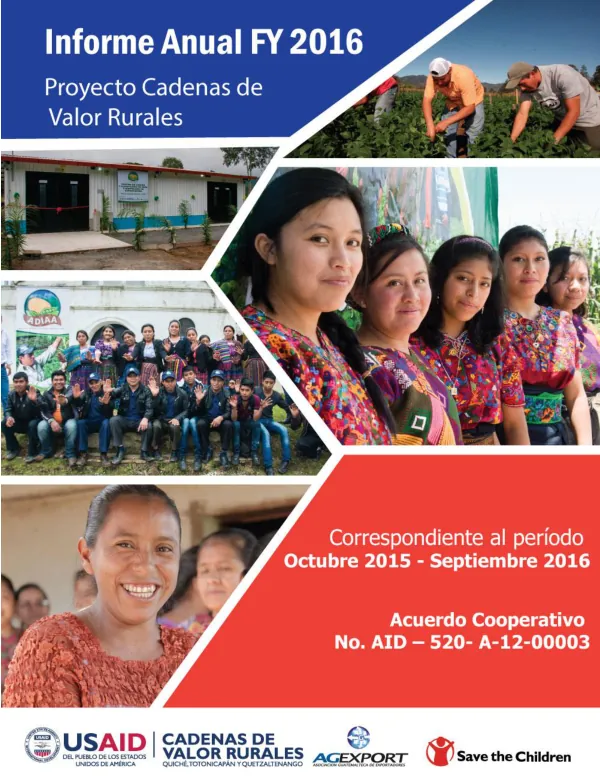
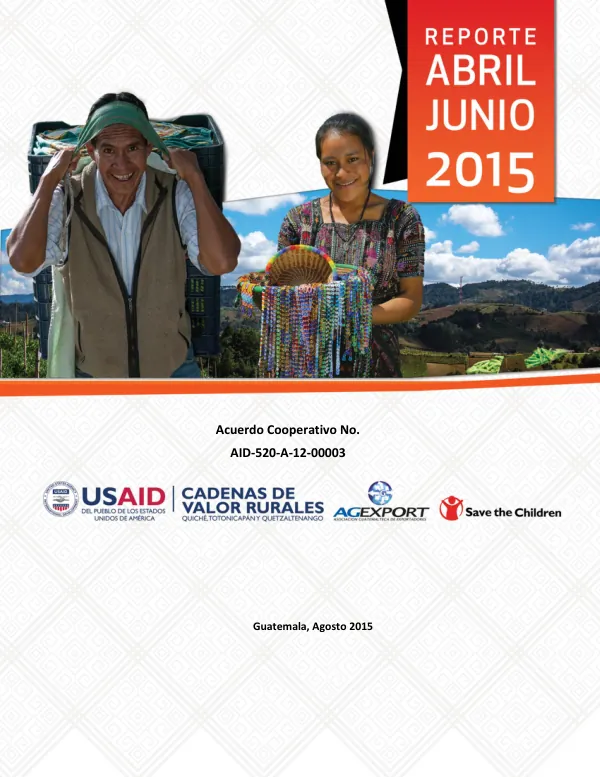
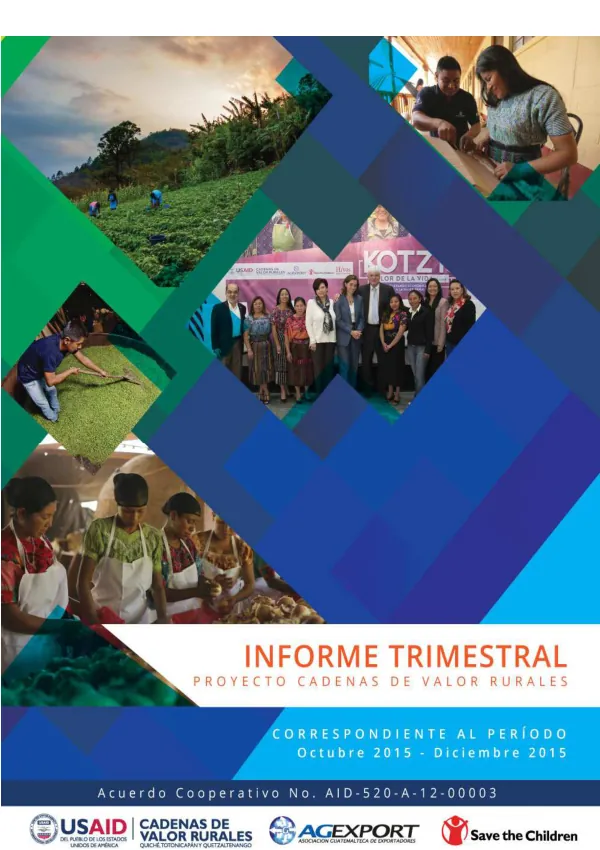
Informe trimestral correspondiente a Octubre a Diciembre 2015 del Proyecto Cadenas de Valor Rurales
Sign inSAVE THE CHILDREN FUND
Informe trimestral correspondiente a Octubre a Diciembre 2015 del Proyecto Cadenas de Valor Rurales
The Cadenas de Valor Rurales project, led by the Asociación Guatemalteca de Exportadores (AGEXPORT), aimed to expand the participation of rural families in selected value chains to increase their incomes.
2015 · 50 pages
Sign in to readA free account is required to download.
Abstract
The project was implemented in 12 municipalities in the departments of Quiché, Totonicapán, and Quetzaltenango, with a total budget of US$ 23,000,000. The project had six components: improving the competitiveness of value chains, expanding participation in rural value chains, improving agricultural productivity, expanding markets and commercialization through private sector innovation, increasing the productivity of crops for self-consumption and improving food utilization, and improving the competitiveness of value chains for handicrafts. During the period of October to December 2015, the project incorporated 17 new value chains, bringing the total number of value chains to 170, with 114 producing vegetables, 9 producing coffee, 21 producing cardamomo, 5 producing deciduous fruits, and 30 producing handicrafts. The project generated sales of US$ 2,930,448, with US$ 1,170,576.45 from vegetables, US$ 861,125.11 from cardamomo, US$ 663,752.12 from deciduous fruits, and US$ 234,994.32 from handicrafts. The project also generated 151,274 days of work, equivalent to 583 jobs, as a result of agricultural activities. With the commercialization generated in the quarter, the project accumulated sales of US$ 16,472,367 and generated a total of 944,320 days of work, representing 3,632 agricultural jobs, as well as 1,446 people employed in other activities. The project's results indicate that the actions taken with small rural producers in the Western Highlands are generating processes that contribute to the improvement of living conditions for many families suffering from poverty and malnutrition. The project's work is also a result of the alliances made by AGEXPORT within the WHIP framework with other projects, such as PAISANO, MASFRIJOL, SIMMIT, and CLUSA. The project's communication efforts included presenting the project's results to important personalities from the United States, including a group of government congressmen, the distinguished Ambassador of the United States to Guatemala, Todd Robinson, and other personalities who have learned about the project's work with different value chains in the departments of Quiché, Quetzaltenango, and Totonicapán. The project's sustainability is ensured through the involvement of various stakeholders, including associations, cooperatives, service providers, brokers, public and private institutions, international cooperation, financial institutions, and others. The project's impact is expected to be long-lasting, as it aims to improve the competitiveness of value chains, expand participation in rural value chains, and increase the productivity of crops for self-consumption and improve food utilization. The project's results demonstrate the effectiveness of the project's approach in improving the living conditions of rural families and increasing their incomes. The project's sustainability and impact are expected to continue beyond the project's lifespan, as it aims to create a lasting impact on the rural economy and improve the well-being of rural families.