CONSERVATION STRATEGY FUND
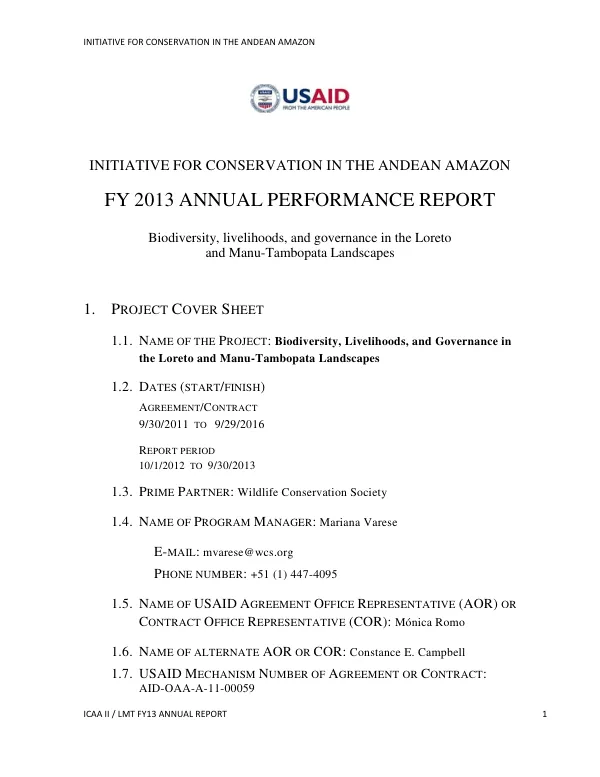
Initiative for Conservation in the Andean Amazon ICAA II / LMT FY13 Annual Report
The Initiative for Conservation in the Andean Amazon (ICAA) II/LMT FY13 Annual Report focuses on conserving biodiversity, securing rural livelihoods, and promoting the sustainable use of natural resources in the Loreto and Manu-Tambopata Landscapes.
2013 · 26 pages
Sign in to readA free account is required to download.
Abstract
The report highlights the achievements of the Wildlife Conservation Society (WCS) and its partners in implementing the five proposed strategies to address the challenges of conservation at the landscape scale. The first strategy, securing land and resource-use rights and coordinating effective governance systems, involved improving management of 1,722,754 hectares of significance for biodiversity and natural resources. This was achieved through a combination of strategies, including working with national and sub-national protected area authorities to strengthen their management, collaborating with indigenous communities to enable their access to legal conservation tools, and partnering with landholders to create and improve management of Private Conservation Areas (ACP). In the Loreto Landscape, the Consortium strengthened management in protected areas such as Pacaya Samiria National Reserve and Tamshiyacu-Tahuayo Community Regional Conservation Area. Training was provided to local experts, university students, and management committee members on wildlife monitoring in a context of climate change. The design of the Tamshiyacu-Tahuayo Community Regional Conservation Area Monitoring Plan was completed, and training was provided to technical staff and local communities on community-based wildlife monitoring. In the Manu-Tambopata Landscape, the Consortium worked to secure tenure and legal recognition of lands under conservation management through private conservation strategies. Technical assistance was provided to the Puerto Prado Indigenous Community to create an ACP, and the Infierno Indigenous Community signed a Community Assembly's Agreement to apply for an ACP within their community land. A legal analysis was completed to identify the main obstacles for indigenous communities to secure land titling, and this analysis will inform the development of an innovative legal tool for indigenous communities to obtain legal recognition of their lands under conservation management. The second strategy, expanding the use of market mechanisms for conservation and sustained poverty alleviation, involved promoting the adoption of an adaptive management approach at the protected area system level. The Consortium worked with the Peruvian National Protected Areas Service (SERNANP) to amend Presidential Resolution N° 205-2010-SERNANP, which provides guidelines for the establishment of Community Regional Conservation Areas (ACRs). The Consortium also provided training materials to the Matsés National Reserve on wildlife management and monitoring. The third strategy, building natural resource governance skills and experience, involved strengthening environmental planning and management at the sub-national level. Workshops were held in Loreto to clarify the competences of regional governments on environmental matters and to discuss problems of overlapping rights over land and resources. A GOREL working group was established to address these issues. The fourth strategy, building strong and effective constituencies for conservation, involved promoting private conservation strategies in Loreto. Training workshops and awareness activities were conducted to promote private conservation strategies, and a legal analysis was completed to identify the main obstacles for indigenous communities to secure land titling. The fifth strategy, scaling-up landscape conservation to the system level by improving effective management of national and regional protected area systems, involved promoting the incorporation of biodiversity and ecosystem offsets into planning and policy instruments. The draft "Guidelines for the development and implementation of an Environment Offset Plan under the framework of the National Environmental Impact Assessment System (SEIA)" was promoted for incorporation into planning and policy instruments. Overall, the ICAA II/LMT FY13 Annual Report highlights the achievements of the WCS and its partners in implementing the five proposed strategies to address the challenges of conservation at the landscape scale. The report demonstrates the importance of a collaborative approach to conservation, involving multiple stakeholders and strategies to achieve sustainable management of natural resources and biodiversity conservation.