CARE
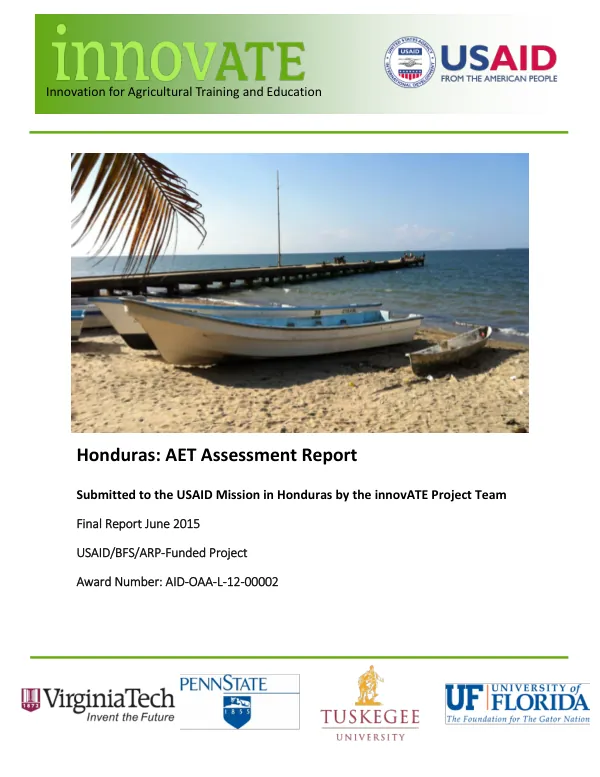
Innovation for Agricultural Training and Education: Honduras: AET Assessment Report
Agricultural Education and Training in Honduras: AET Assessment Report The agricultural development initiative in Honduras began with a scoping assessment conducted by the innovATE project team in 2014.
2015 · 78 pages
Sign in to readA free account is required to download.
Abstract
The assessment focused on the current and future demand for agricultural education and training (AET) for rural youth in the north Atlantic coastal region of Honduras, particularly in the Garífuna communities. This region is characterized by an insecure environment due to criminal activities, including narcotics trafficking, and a marginalized Afrohonduran Garífuna population with an estimated population of between 98,000 and 300,000. The assessment aimed to identify gaps in the human and institutional capacity of in-country AET systems, as well as to provide recommendations for potential programs to address these gaps. The innovATE team conducted interviews and focus groups with more than 50 stakeholder groups representing the formal and non-formal education sectors, community and Garífuna organizations, NGOs, government agencies, and private-sector employers. The assessment revealed major gaps in the relevance and quality of both basic and higher education in Honduras, particularly for students from the Garífuna communities. There are significant mismatches between the supply of graduates from the secondary and tertiary education systems versus the demands of the labor market. The innovATE team identified the need to improve infrastructure, curriculum, and teacher quality in Garífuna community schools, as well as to increase access to higher education for Garífuna students. Recommendations for the Formal Education Sector include improving infrastructure, reforming curriculum, implementing early inclusion of agriculture courses, improving teacher quality, increasing public-private partnerships, and developing work-study-service programs. Recommendations for the Non-Formal Education Sector include exploring opportunities to leverage technical training capabilities, expanding existing programs for at-risk youth, providing training for entrepreneurship and small business management, and building relationships with the private sector. Recommendations for Garífuna Community Development include supporting the development of community-based tourism programs, supporting the development of cooperatives and community entrepreneurial projects, improving access to markets, establishing a community consultation process, and providing support for local financial institutions. Recommendations for Policy Reform include supporting regionally relevant educational reform, supporting banking sector reform, and supporting land tenure and access reform. The assessment also highlighted the need to address the impact of out-migration on the supply of a skilled agricultural workforce in the North Atlantic coastal regions of Honduras. The innovATE team recommended developing some possible rural economic change scenarios that may shift the future demand for skilled labor in the target region. The report provides a comprehensive analysis of the current state of AET in Honduras and offers recommendations for addressing the gaps and mismatches identified. The innovATE team's assessment and recommendations aim to strengthen youth programming and participation in support of development objectives, particularly in the north Atlantic coastal region of Honduras.