USAID DEC
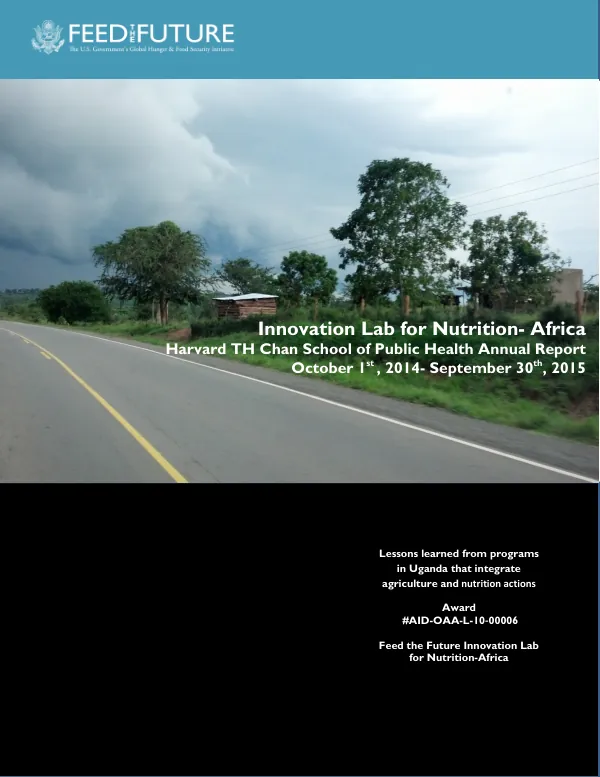
Innovation Lab for Nutrition-Africa Harvard TH Chan School of Public Health Annual Report 2014-2015
Sign inSCHOOL OF PUBLIC HEALTH T. H. CHAN DE HARVARD
Innovation Lab for Nutrition-Africa Harvard TH Chan School of Public Health Annual Report 2014-2015
The Feed the Future Innovation Lab for Nutrition-Africa, led by the Harvard TH Chan School of Public Health, collaborated with Makerere University and other partners in Uganda to conduct research on the impact of agricultural and nutrition interventions on household livelihoods and maternal and child nutritional outcomes.
2015 · 8 pages
Sign in to readA free account is required to download.
Abstract
The research activities were closely linked to the evaluation of USAID's Uganda Community Connector Project (UCCP). The Uganda Panel Study, a collaborative effort among Harvard, Makerere University, and the ME, aimed to evaluate the impact of UCCP on household livelihoods and maternal and child nutritional status. The study collected representative data from households in randomly selected districts initiating UCCP activities at varying stages of UCCP's scaling-up plan. Achievements during the project year included extensive data cleaning and documentation of baseline data in partnership with the data manager at Makerere, creation of key analysis variables, and data analysis. A draft analysis using baseline panel data of linkages between linear growth and stunting in young children and the adoption and use of agricultural technologies and practices was presented to the study team in June 2014 and is being revised based on received feedback for submission to a scientific journal. Input was also provided on other analyses being conducted by the Makerere team. Institutional approvals for research activities have been maintained over the project year, and technical support was provided for the second round of panel data collection during the project year. The Uganda Birth Cohort Study, also a collaborative effort among Harvard, Makerere University, and the ME, will examine the effect of interventions that integrate nutrition, health, agriculture, and livelihoods on maternal and child nutritional outcomes. Compared with the panel study, the cohort study will use a wider range of data collection methods, including interviews and physical measurements of children and mothers. The study aims to provide insights into the mechanisms by which UCCP impacts maternal and child nutritional outcomes. The research program in Uganda is closely linked to the evaluation of UCCP, and all research activities are conducted in close collaboration with Makerere University and the ME. Effort is made to include training and active involvement of junior staff in research activities to build capacity in research on agriculture, nutrition, and health linkages. The budget line for the Uganda-based Research Specialist responsible for supervising all research activities conducted in collaboration among Harvard, Makerere, and Tufts was moved to the ME, and joint supervision of this research specialist continues to occur among the Makerere PI and faculty at Harvard and Tufts through weekly calls and review of data collection progress. The research studies in Uganda are designed to provide insights into the impact of agricultural and nutrition interventions on household livelihoods and maternal and child nutritional outcomes. The studies aim to contribute to the development of effective policies and programs to improve nutrition and health outcomes in Uganda and other countries in Africa.
Related documents