USAID DEC
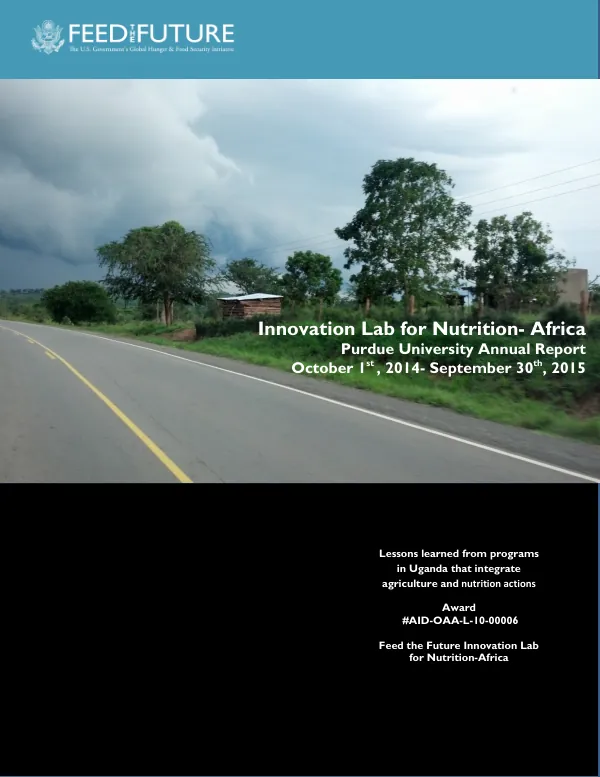
Innovation Lab for Nutrition-Africa: Purdue University Annual Report Year 5 (2014-2015)
Sign inNASA
Innovation Lab for Nutrition-Africa: Purdue University Annual Report Year 5 (2014-2015)
The Innovation Lab for Nutrition-Africa, led by Purdue University, focuses on addressing chronic and widespread child malnutrition in Uganda.
2015 · 8 pages
Sign in to readA free account is required to download.
Abstract
The lab's research and capacity-building activities aim to fill knowledge gaps on key issues related to agriculture, health, and nutrition. The project is closely aligned with the USAID Community Connector goals and objectives, as well as the Feed-the-Future orientation of delivering "Purpose-Driven Research." Research activities are centered on policy-relevant, hypothesis-driven research on agriculture and nutrition. The lab has secured access to various datasets, including the Uganda National Household Survey, Uganda Demographic and Health Survey data, and remotely-sensed satellite data. These datasets are being analyzed using innovative approaches to report findings in working papers, journal articles, and policy briefs. The research is part of two student MS theses and constitutes the ongoing focus of one PhD student, George Omiat, at Purdue. The lab has also conducted discrete socioeconomic analysis on key topics, including price analysis and fuel use and upper respiratory disease. The price analysis involved compiling, cleaning, and analyzing monthly price data for 23 markets and 29 commodities over a 10-year period. This data was linked with remotely-sensed data on vegetative health and combined with rainfall data and DHS child-growth data. Research on the drivers of food prices, the cost of nutritionally adequate diets over time and space, and the connections between food prices and child nutrition are being conducted. Capacity-building activities are focused on degree training, with considerable effort devoted to identifying a student from Uganda for degree training at Purdue. George Omiat, a junior faculty member at Makerere University, was admitted to the PhD program in Agricultural Economics at Purdue University in August 2012 and passed his qualifying examination in the summer of 2014. A Nigerian student also completed her MS in Agricultural Economics at Purdue in Year 5, studying connections between acute respiratory infection and child growth outcomes. The lab has faced challenges in implementing proposed activities, including delays in initial approval and launch of the project. However, solutions have been applied or are to be applied, including integrating activities with the Management Entity and the mission. The lab has also taken steps to use unexpended funds to support George Omiat through completion of his degree.