ABT ASSOCIATES
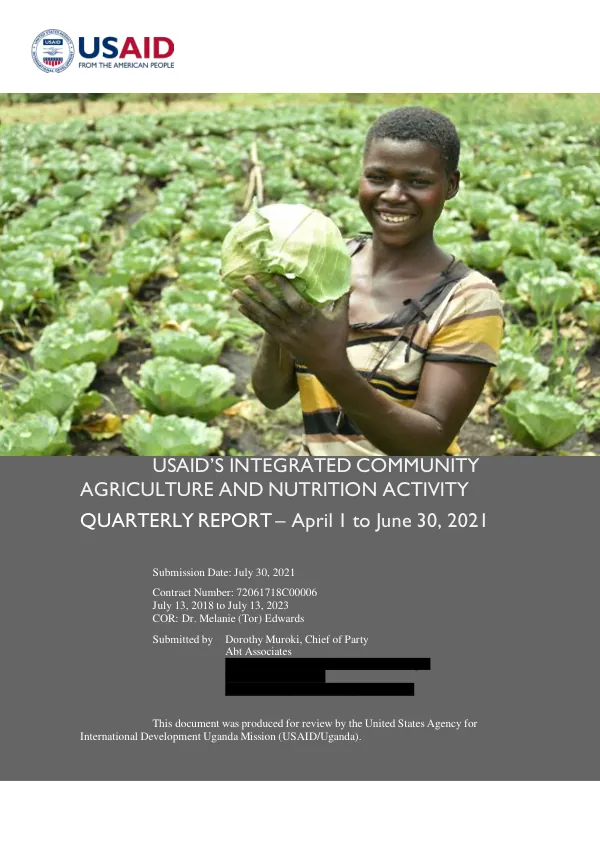
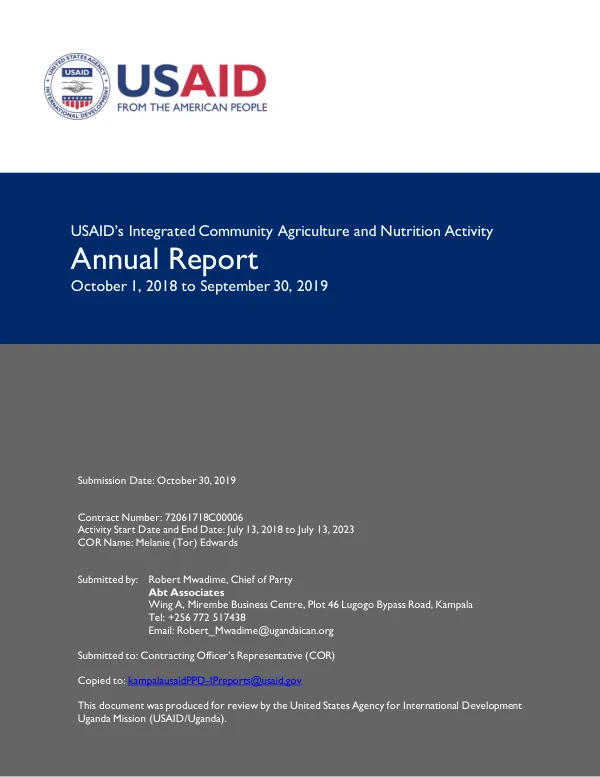
USAID’s Integrated Community Agriculture and Nutrition Activity Annual Report
The Integrated Community Agriculture and Nutrition Activity (ICAN) is a USAID-funded project aimed at enhancing the resilience of vulnerable households in eight districts of Uganda.
2019 · 35 pages
Sign in to readA free account is required to download.
Abstract
The project's goal is to increase economic opportunities for poor households, stabilize their access to and consumption of diverse and nutritious diets, and increase social capital by reinforcing relationships among formal governance systems and communities. ICAN works with community groups to maximize economic opportunities for vulnerable households, focusing on three key strategic themes: Resilience, Partnerships, and Collaboration, Learning and Adapting (CLA). The project emphasizes the importance of strengthening community groups, primarily village savings and loan associations (VSLAs), to support vulnerable households and move them along a Pathway to Self-Reliance. The project's key targets include increasing economic opportunities for 116,000 poor households, reaching more than 184,000 mothers with nutrition services and 23,000 adolescents with life and entrepreneurship skills, reducing stunting by 5% among children of households participating in ICAN-supported activities, and increasing participation in local planning for environmental conservation efforts for more than 11,000 households. As of the end of FY19, ICAN had achieved significant progress towards its targets. The project had reached 43,200 individuals with USG food security programs, with 84.1% of beneficiary households adopting various tools, approaches, and technology that reduce or mitigate shocks for specific vulnerabilities. Additionally, ICAN had supported 27,000 individuals participating in group-based savings, micro-finance, or lending programs, with 76.5% of households having two or more sources of livelihood as a result of USG assistance. The project had also made significant progress in strengthening agricultural productivity and livelihoods, with 19,000 farmers and others applying improved technologies or management practices with USG assistance. Furthermore, ICAN had supported 62 for-profit private enterprises, producers' organizations, water users' associations, women's groups, trade and business associations, and community-based organizations (CBOs) that applied or demanded improved organization-level technologies or management practices with USG assistance. In terms of access to non-agriculture-based livelihood options, ICAN had reached 1,023 people with training, grants, loans, or linkages to job skills programs for non-agriculture-based livelihood options. Additionally, the project had supported 352 households that had participated in formal agricultural markets in the last 12 months with USG assistance. Overall, ICAN's progress towards its targets demonstrates the project's commitment to enhancing the resilience of vulnerable households in Uganda. The project's focus on strengthening community groups, improving agricultural productivity and livelihoods, and increasing access to non-agriculture-based livelihood options has made significant contributions to the well-being of poor households in the project's target areas.
Related documents