USAID DEC
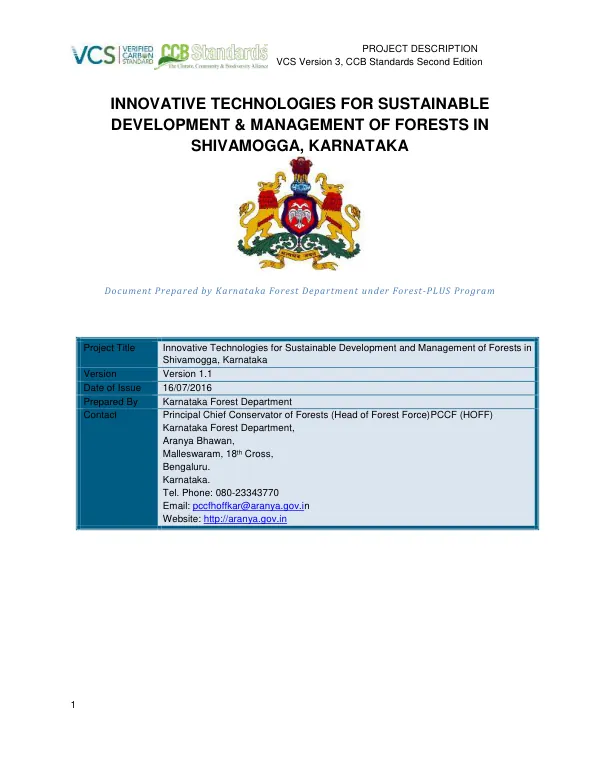
Innovative Technologies for Sustainable Development and Management of Forests in Shivamogga, Karnataka
Sign inUSAID DEC
Innovative Technologies for Sustainable Development and Management of Forests in Shivamogga, Karnataka
The Innovative Technologies for Sustainable Development and Management of Forests in Shivamogga, Karnataka project aims to promote sustainable forest management and development in the Shivamogga Forest Circle of Karnataka.
2016 · 234 pages
Sign in to readA free account is required to download.
Abstract
The project is located in the Western Ghats region, which is characterized by a diverse range of flora and fauna. The project area covers approximately 1,500 square kilometers and includes various forest types, including tropical dry deciduous and tropical moist deciduous forests. The project objectives are to promote sustainable forest management practices, reduce greenhouse gas emissions, and improve the livelihoods of local communities. The project will achieve these objectives through the implementation of several activities, including conservation plantation and assisted natural regeneration, sustainable grazing, reduced consumption of non-renewable fuelwood, and complete stopping of encroachment. The project will also promote better forest management practices, including reduced extraction of small timber and improved forest monitoring. The project will be implemented by the Karnataka Forest Department, with technical support from the Forest-PLUS Program. The project will involve the participation of local communities, including farmers, herders, and forest dwellers. The project will also engage with various stakeholders, including government agencies, NGOs, and private sector organizations. The project will have a significant impact on the climate, community, and biodiversity of the region. The project is expected to reduce greenhouse gas emissions by 1.5 million tons of CO2 equivalent per year. The project will also improve the livelihoods of local communities by providing them with alternative income sources and improving their access to forest resources. The project will also contribute to the conservation of biodiversity by promoting sustainable forest management practices and reducing the impact of human activities on the forest ecosystem. The project will be implemented over a period of 10 years, with a project crediting period of 10 years. The project will be monitored and evaluated regularly to ensure that it is achieving its objectives and making progress towards its goals. The project will also have a grievance mechanism in place to address any concerns or issues raised by stakeholders. The project will be financed through a combination of government funding and private sector investment. The project will also generate employment opportunities for local communities, including training and capacity building programs for forest staff and local communities. The project will also promote the use of innovative technologies, including remote sensing and GIS, to monitor and manage the forest ecosystem. The project will have a significant impact on the Shivamogga Forest Circle, improving the livelihoods of local communities and contributing to the conservation of biodiversity. The project will also serve as a model for sustainable forest management and development in other parts of the country.
Related documents