COASTAL RESOURCES CENTER
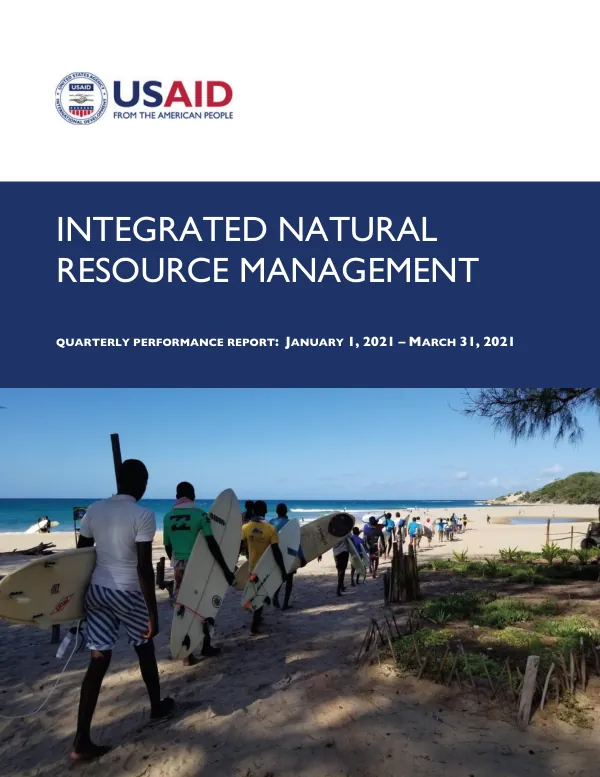
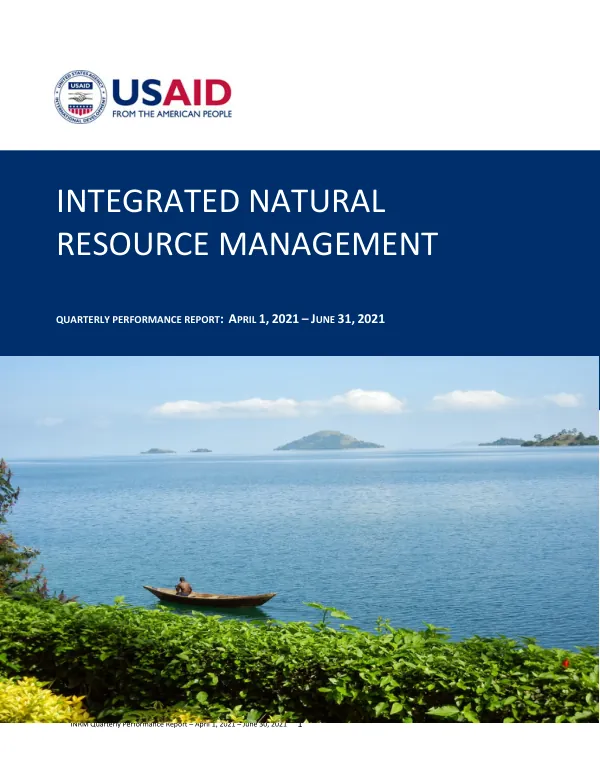
INRM Quarterly Performance Report – April 1, 2021 – June 30, 2021
Integrated Natural Resource Management (INRM) is a five-year task order under the Strengthening Tenure and Resource Rights (STARR) II Indefinite Delivery Indefinite Quantity (IDIQ) contract.
2021 · 28 pages
Sign in to readA free account is required to download.
Abstract
INRM supports multiple Offices in the Bureau for Development, Democracy and Innovation (DDI) and provides strategic support and facilitation to USAID's Missions, technical offices, and other Operating Units on integrated environment programming. The task order is aligned with the Agency's Environmental and Natural Resource Management (ENRM) Framework and aims to strengthen the impacts of USAID's core environmental programming by recognizing synergies, adopting best practices, and building broader constituencies for integrated programming. INRM works across the USAID Program Cycle, supports assessment, strategy, activity design, piloting of new approaches, adaptive management, monitoring, evaluation, and learning, and communications. The task order is implemented by DAI and seven subcontractors, including the Center for Biodiversity and Conservation at the American Museum of Natural History, Coastal Resource Center, Conservation Strategy Fund, New America, Resource Equity, Social Impact, and Stantec. INRM uses a mix of core team expertise and uniquely qualified technical assistance from this team of subcontractors to strengthen the impacts of USAID's integrated environmental programming. The INRM Quarterly Performance Report for the period of April 1, 2021, to June 30, 2021, highlights several key achievements. Three contractual deliverables, the Monitoring, Evaluation, and Learning Plan, Gender and Social Inclusion Strategy, and Branding and Marking Plan, were approved. The INRM Environmental Governance Lead gave a "tech talk" to ENRM focal group members on "Thinking and Working Politically: Why it Matters for Environmental Specialists." The INRM CKM team conducted 11 virtual interviews with members of the ENRM focal groups and three interviews with members of other USAID offices, with a total of 24 participants. The INRM team also collaborated with USAID to design and refine a voluntary questionnaire about ENRM CKM needs for Mission staff, which was distributed on Friday, June 25th, 2021. The information gathered will help inform two ENRM CKM workshops scheduled in quarter four. In April and May 2021, INRM conducted nine interviews with 14 individuals from the USAID/Tanzania Mission and five implementing partner organizations in Tanzania. The aim of the interviews was to understand how these stakeholders assessed and/or used USAID's Mobile Applications to Secure Tenure (MAST); gather lessons learned; and identify potential areas for improvement. The INRM Quarterly Performance Report also highlights the importance of integrated programming across sectors traditionally classified as "environmental," such as land use, forestry, and biodiversity conservation, as well as many sectors that traditionally have not been linked to environment programming but are in fact strongly connected, such as food security, health, and governance. By using a multi-sectoral lens, INRM aims to strengthen the impacts of USAID's core environmental programming and build broader constituencies for integrated programming. The report also notes that the INRM MEL plan is in the early stages of implementation, and the annual report due September 30, 2021, will include MEL data and learning. The INRM Quarterly Performance Report provides an update on progress and learning from the preceding three months and highlights the importance of continued collaboration and coordination among stakeholders to achieve the goals of the INRM task order.
Related documents