USAID
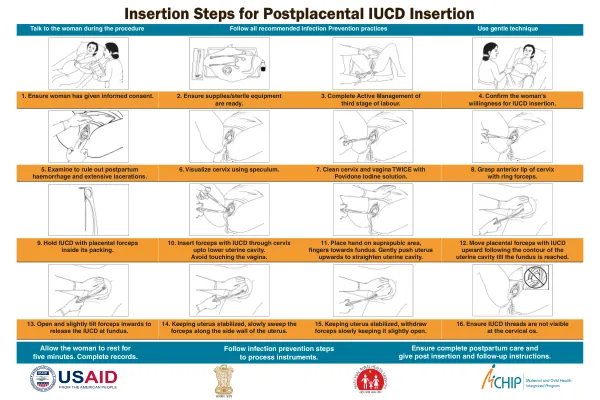
Insertion Steps for Postplacental IUCD Insertion
Postplacental IUCD insertion is a procedure that can be performed immediately after delivery to provide long-term contraception.
2013 · 1 pages
Sign in to readA free account is required to download.
Abstract
The procedure begins with ensuring the woman has given informed consent and that all necessary supplies and sterile equipment are available. Active Management of the third stage of labor is completed before proceeding with the IUCD insertion. The woman's willingness for IUCD insertion is confirmed, and a thorough examination is conducted to rule out postpartum hemorrhage and extensive lacerations. The cervix is visualized using a speculum, and the area is cleaned twice with Povidone Iodine solution to prevent infection. The anterior lip of the cervix is grasped with ring forceps, and the IUCD is held in place with placental forceps inside its packing. The forceps with the IUCD are then inserted through the cervix into the lower uterine cavity, taking care to avoid touching the vagina. The uterus is gently pushed upwards to straighten the uterine cavity, and the forceps are moved upward following the contour of the uterine cavity until the fundus is reached. The forceps are then opened and slightly tilted inwards to release the IUCD at the fundus. The uterus is stabilized, and the forceps are slowly swept along the side wall of the uterus. The forceps are then slowly withdrawn, keeping it slightly open, and the IUCD threads are checked to ensure they are not visible at the cervical os. The woman is allowed to rest for five minutes, and complete records are made. Infection prevention steps are followed to process the instruments, and the woman is provided with post-insertion and follow-up instructions as part of complete postpartum care.