USAID
Protocol for Essential Newborn Care
Newborn care is a critical aspect of maternal and child health.
3 pages
Sign in to readA free account is required to download.
Abstract
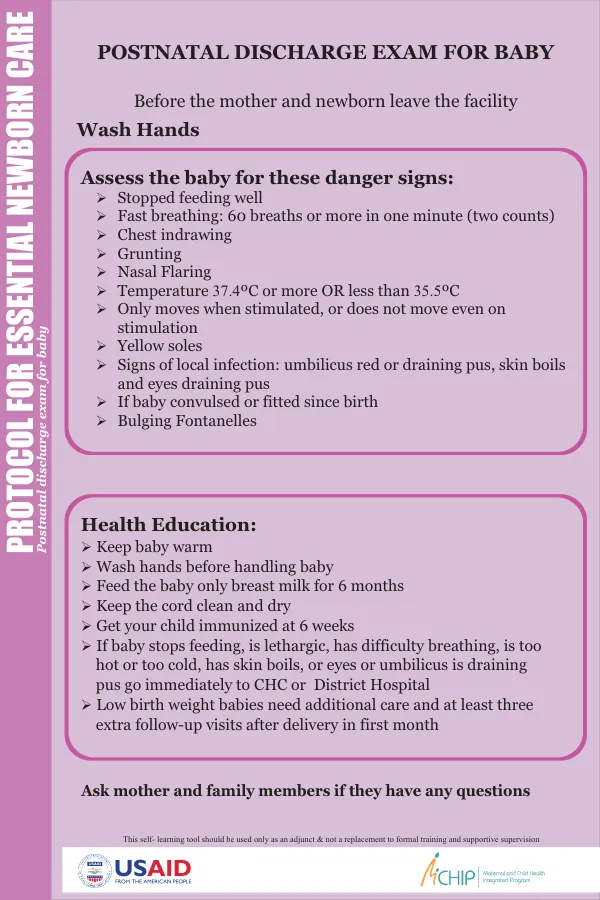
Essential newborn care involves a range of interventions aimed at promoting the health and well-being of newborns. One of the key components of essential newborn care is warmth, which is essential for maintaining the newborn's body temperature. Newborns should be kept warm by covering both the mother and baby, and when unable, the mother-in-law or father should keep the baby skin to skin. Delaying bathing for as long as possible is also recommended, and when bathing, the room should be warm and the baby should be dried quickly and put back in skin to skin position. Breastfeeding is another critical aspect of essential newborn care. Small babies can often suckle without problems, but if needed, assistance with position and attachment may be required. If the baby is unable to suckle or tires easily, expressed breast milk can be given with a palladi until able to suckle. Small babies should feed often, about every 2 hours during the day and night. Hygiene is also essential, and everyone needs to wash their hands before touching the baby, as small babies are very susceptible to infections. Danger signs are an important aspect of essential newborn care, and families need to recognize signs that the baby may be sick. Health workers must review these signs before discharge, and explain the importance of getting to a referral facility rapidly if any of these signs are found. Encouraging the mother and giving her confidence that by following this method she is capable of providing the best care for her baby is also essential. Newborns who weigh between 1.5 kg and 2.5 kg require special care. These babies need to be monitored closely, and their temperature, passage of urine and stool, umbilical stump, eyes, and skin should be checked regularly. They should also be fed frequently, about every 2 hours during the day and night, and their mother should be encouraged to breastfeed. Low birth weight babies need at least three extra follow-up visits after delivery in the first month. Postnatal discharge examination for the baby is an essential component of essential newborn care. This examination should be conducted before the mother and newborn leave the facility, and should include checking the mother's uterus for firmness, looking for heavy bleeding, checking vaginal discharge, taking temperature, taking blood pressure and pulse, checking urination, checking breasts, and asking how the mother feels and her general condition. The baby's temperature, passage of urine and stool, umbilical stump, eyes, and skin should also be checked, and the baby should be observed breastfeeding at least twice and at discharge.