USAID DEC
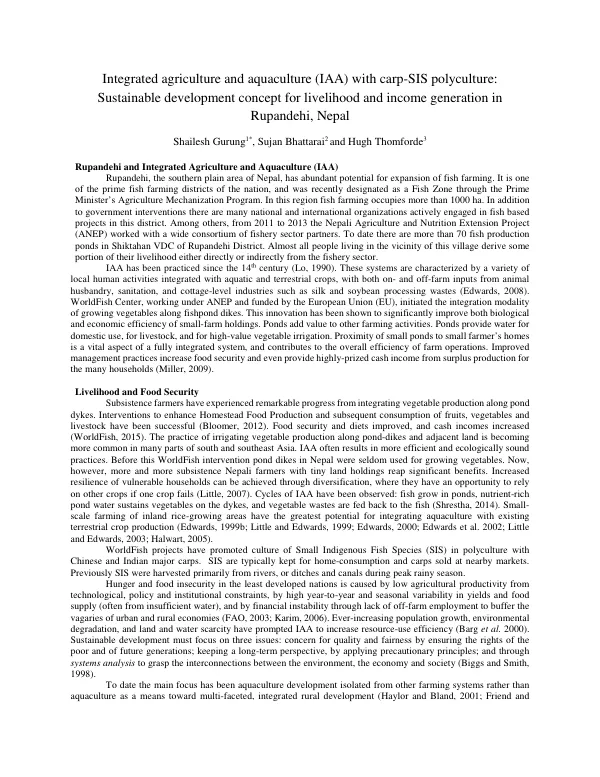
Integrated agriculture and aquaculture (IAA) with carp-SIS polyculture: Sustainable development concept for livelihood and income generation in Rupandehi, Nepal
Sign inTRIBHUVAN UNIVERSITY
Integrated agriculture and aquaculture (IAA) with carp-SIS polyculture: Sustainable development concept for livelihood and income generation in Rupandehi, Nepal
Integrated agriculture and aquaculture (IAA) with carp-SIS polyculture is a sustainable development concept for livelihood and income generation in Rupandehi, Nepal.
2018 · 6 pages
Sign in to readA free account is required to download.
Abstract
The region has abundant potential for expansion of fish farming, with over 1000 ha of fish farming area and more than 70 fish production ponds in Shiktahan VDC. The fishery sector is a significant source of livelihood for the local population, with almost all people in the vicinity deriving some portion of their income directly or indirectly from the sector. IAA has been practiced since the 14th century, characterized by the integration of local human activities with aquatic and terrestrial crops, as well as on- and off-farm inputs from animal husbandry, sanitation, and cottage-level industries. The WorldFish Center, working under the Nepali Agriculture and Nutrition Extension Project (ANEP) and funded by the European Union, initiated the integration modality of growing vegetables along fishpond dikes. This innovation has been shown to significantly improve both biological and economic efficiency of small-farm holdings. The WorldFish-ANEP project focused on Shiktahan Village in the Rupandehi District of southern Nepal, where 30 farmers participated in the study. The project aimed to promote the culture of Small Indigenous Fish Species (SIS) in polyculture with Chinese and Indian major carps. The results showed that the total number of carp stocked per kattha averaged 1850, weighing about 10 kg respectively, with an average harvest of 1293 carp per kattha, weighing 762 kg/hattha. The total income from fish and dike vegetables was impressive, with Rs. 183,416 from the sale of carp and Rs. 76,327 from vegetables. The project also showed that the consumption patterns of nutrient-rich SIS toward the conclusion of the project intervention remained consistent, with higher consumption of Puntius sophore at 55% and the lowest consumption of Amblypharyngodon mola at 20%. The yields of Amblypharyngodon mola were very low due to the lack of knowledge of basic biological habits, appropriate culture techniques, and even breeding season. The participant households reported that maximum demand for SIS was never met, notwithstanding increased convenience and availability due to stocking in ponds. The project successfully introduced the integration of fish with dike vegetable farming in Siktahan Village, indicating that integrated farming on these family-size farms is highly appreciated and productive. The findings suggest that if disseminated to other districts of southern Nepal, they will improve the quality of life through more stable, resilient farming practices, and higher cash income. The project's success highlights the potential of IAA with carp-SIS polyculture as a sustainable development concept for livelihood and income generation in Rupandehi, Nepal.
Related documents