USAID DEC
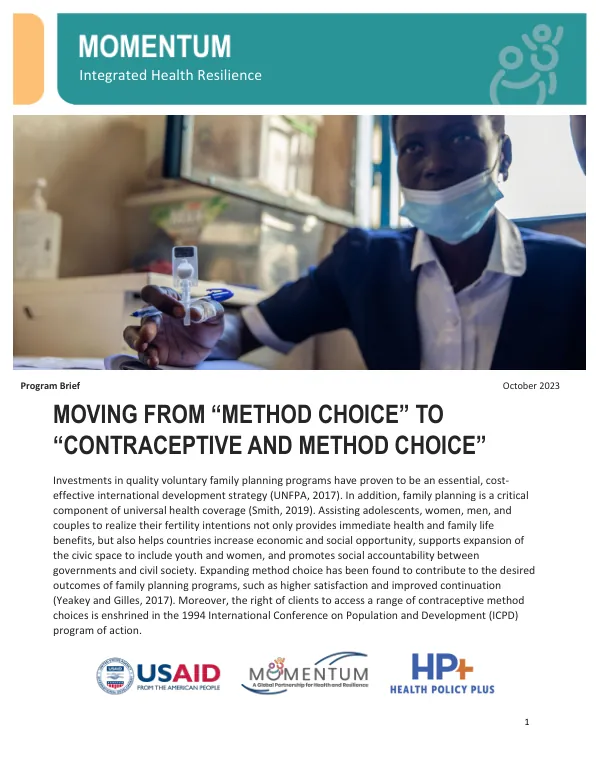
Integrated Health Resilience: MOVING FROM “METHOD CHOICE” TO “CONTRACEPTIVE AND METHOD CHOICE”
Sign inFHI 360
Integrated Health Resilience: MOVING FROM “METHOD CHOICE” TO “CONTRACEPTIVE AND METHOD CHOICE”
Integrated Health Resilience: Moving from "Method Choice" to "Contraceptive and Method Choice" Investments in quality voluntary family planning programs have proven to be an essential, cost-effective international development strategy.
2023 · 12 pages
Sign in to readA free account is required to download.
Abstract
Family planning is a critical component of universal health coverage, providing immediate health and family life benefits, as well as economic and social opportunities. Expanding method choice has been found to contribute to the desired outcomes of family planning programs, such as higher satisfaction and improved continuation. The right of clients to access a range of contraceptive method choices is enshrined in the 1994 International Conference on Population and Development (ICPD) program of action. The United States Agency for International Development's (USAID) programs have promoted contraceptive method choice for decades. Typically, program efforts have focused on the supply side of health systems strengthening, including ensuring the availability of a range of methods at service delivery points, training providers, and changing perceptions about limiting method options to specific groups. Such programs have also included investing in client and community education to create awareness and acceptability of new or under-used methods. Additionally, work has focused on the development and introduction of new contraceptive technologies that meet complex and changing client demands. A consideration of the increased focus on the individual and programmatic experience leads to the recognition that decision-making happens most often outside and prior to provider-client interactions. Reproductive decision-making should be viewed as a chain of influences and events, taking place in various spheres in the socio-ecological model. This points to the need to recognize other markers of success in FP programming beyond the systems-focused "uptake" to include client-centered goals, such as the realization of an individual's or couple's reproductive intentions. A new framework, the Contraceptive and Method Choice Framework, has been developed to respond to these trends in family planning and reproductive health. The Contraceptive and Method Choice Framework recognizes that contraceptive choice is influenced by myriad individual, relational, sociocultural, and health system factors beyond method choice. This model also recognizes that clients increasingly have more service delivery modalities through which to support their contraceptive method choice, including self-administration and self-management. The framework is rooted in basic assumptions, including the need for individuals and/or couples to employ a variety of contraceptive strategies throughout their life course to meet their reproductive intentions, and the requirement for functional access to a full range of evidence-based contraceptive methods and related quality health services. The Contraceptive and Method Choice Framework illustrates the various individual, relational, social, cultural, and health systems factors that influence the chain of events in realizing an individual's and couples' reproductive intentions. By placing individual agency and the realization of reproductive intent at the center, the framework recognizes that "method choice" encompasses two decisions by clients: 1) the choice to use, or not use, contraception ("contraceptive choice") to realize the individual's or couple's reproductive intent; and 2) if choosing to avoid pregnancy, the decision about which contraceptive method to use. This framework encourages programs to redefine success beyond contraceptive uptake to include other markers of success in helping clients to realize their reproductive intentions.