TETRA TECH
Supporting Gender Integration in Customary Land Documentation in Malawi
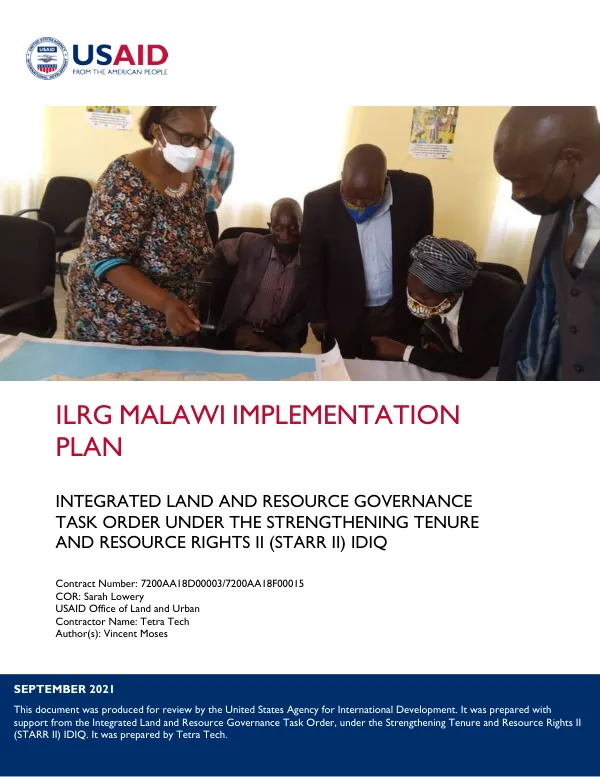
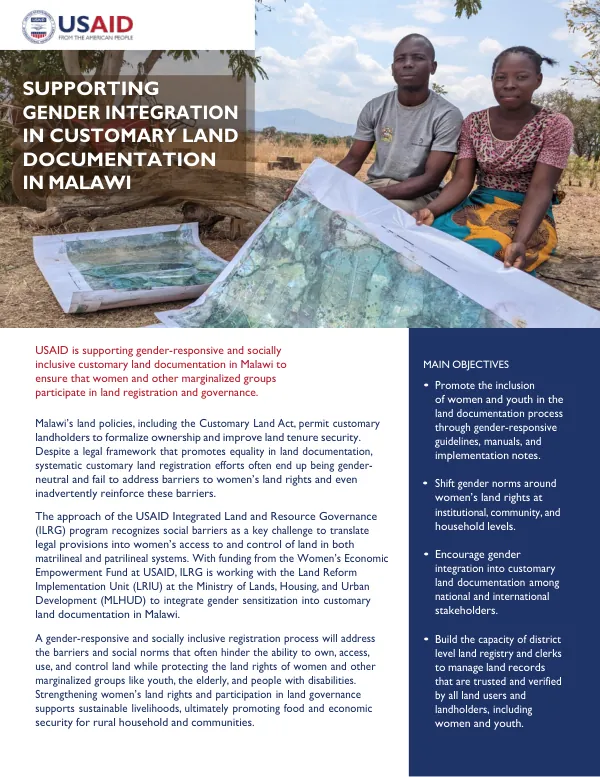
The USAID Integrated Land and Resource Governance (ILRG) program is supporting gender-responsive and socially inclusive customary land documentation in Malawi.
2021 · 2 pages
Sign in to readA free account is required to download.
Abstract
The program aims to ensure that women and other marginalized groups participate in land registration and governance. Malawi's land policies, including the Customary Land Act, permit customary landholders to formalize ownership and improve land tenure security. However, systematic customary land registration efforts often end up being gender-neutral and fail to address barriers to women's land rights. The ILRG program recognizes social barriers as a key challenge to translate legal provisions into women's access to and control of land in both matrilineal and patrilineal systems. With funding from the Women's Economic Empowerment Fund at USAID, ILRG is working with the Land Reform Implementation Unit (LRIU) at the Ministry of Lands, Housing, and Urban Development (MLHUD) to integrate gender sensitization into customary land documentation in Malawi. A gender-responsive and socially inclusive registration process will address the barriers and social norms that often hinder the ability to own, access, use, and control land while protecting the land rights of women and other marginalized groups. The ILRG Malawi activity will support the LRIU in documenting customary land in the Traditional Authority Mwansambo, Nkhotakota District, Central Region. The activity will document up to 18 group village headpersons, some 5,000 to 10,000 parcels, and support government to ensure gender-responsive and socially inclusive approaches inform ongoing efforts. ILRG will finance three learning platform meetings that bring together government, academia, communities, traditional authorities, and civil society to consolidate experience and build momentum for gender-responsive and socially inclusive customary land documentation approaches. The ILRG program's goals contribute to the Government of Malawi's objectives related to customary land documentation as well as USAID's priority of advancing gender equality and women's empowerment. The program aims to promote the inclusion of women and youth in the land documentation process through gender-responsive guidelines, manuals, and implementation notes. It also seeks to shift gender norms around women's land rights at institutional, community, and household levels. Furthermore, the program aims to encourage gender integration into customary land documentation among national and international stakeholders and build the capacity of district-level land registry and clerks to manage land records that are trusted and verified by all land users and landholders, including women and youth. The expected outcomes of the ILRG program include the benefit of 45,000 people from gender-responsive customary land documentation with the issuance of land certificates, an improved land administration structure that can support future land documentation processes, and more gender-responsive and accountable public sector and customary land authority.
Related documents