USAID DEC
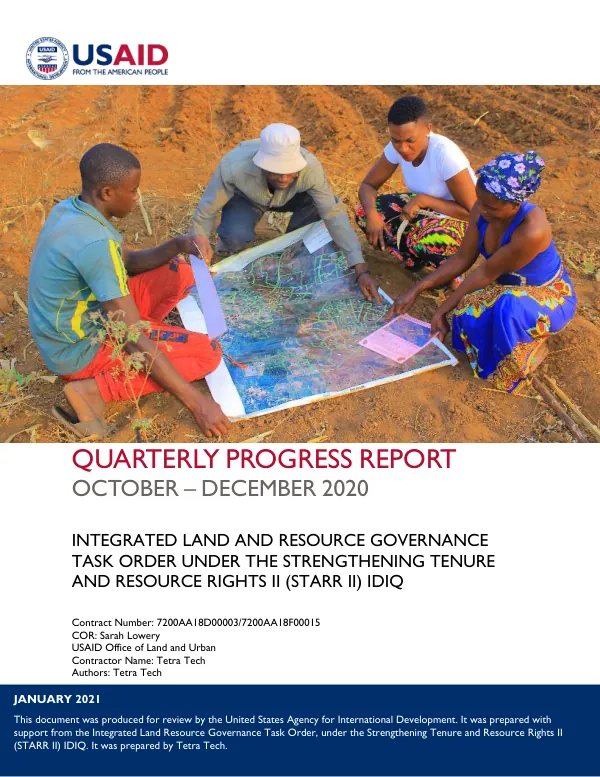
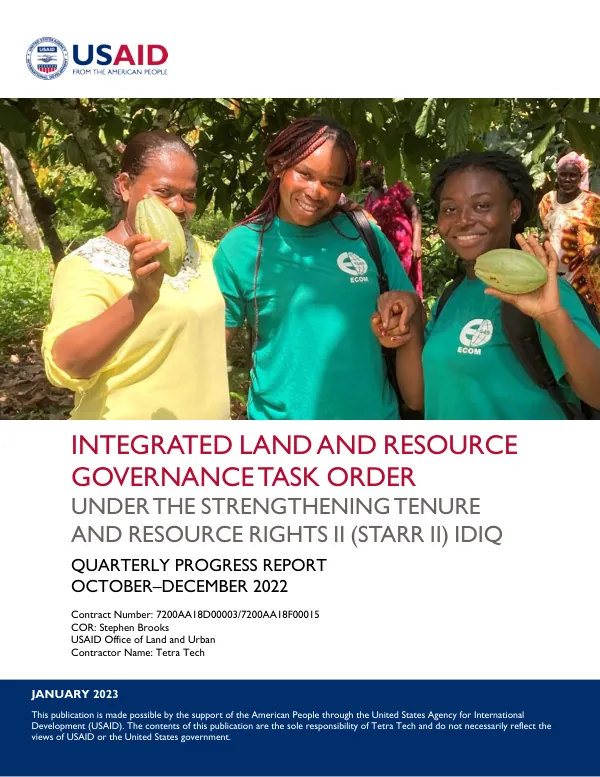
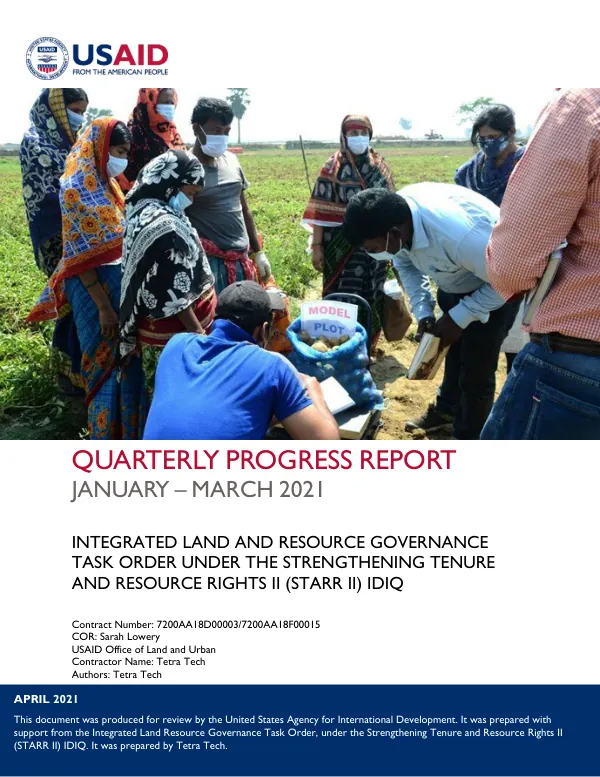
Integrated Land and Resource Governance Task Order Quarterly Progress Report for January-March 2021
Sign inTETRA TECH
Integrated Land and Resource Governance Task Order Quarterly Progress Report for January-March 2021
Integrated Land and Resource Governance (ILRG) activities continued under the Strengthening Tenure and Resource Rights II (STARR II) IDIQ during the January – March 2021 quarter.
2021 · 65 pages
Sign in to readA free account is required to download.
Abstract
The project focused on implementing workplan activities, adapting to the COVID-19 pandemic, and addressing challenges in various countries. The COVID-19 pandemic had a significant impact on ILRG activities, affecting staff, implementation of the workplan, budget, and expenditures. Staff experienced disruptions, and some activities were delayed or modified to accommodate pandemic-related restrictions. The project team implemented COVID-19 response activities, including remote work arrangements, to minimize disruptions. ILRG project activities were ongoing in several countries, including Mozambique, Zambia, Mexico, and India. In Mozambique, the project focused on management and administration, field activities, policy support, gender considerations, sustainability, and self-reliance. In Zambia, activities included documenting and administering rights for economic growth, improved natural resource management, advancing community-based planning and governance, research and learning, and scaling and sustainability. In Mexico, the project focused on land governance and community land use planning, cost recovery farm-level tenure documentation, farm rehabilitation services, and tree tenure. In India, activities included management and administration, increasing women's empowerment and gender equality at the farm, group, and community level, strengthening PepsiCo's global and local gender knowledge, awareness, and capabilities, leveraging additional government and private sector partnerships for sustainability and scale, communications, and sustainability and self-reliance. The project also supported various completion activities, including the Women's Global Development and Prosperity Initiative (W-GDP) in Malawi, the Cocoa Sector Partnership, and cross-cutting activities. Additionally, the project supported the Public-Private Alliance for Responsible Minerals Trade and the LINDT cooperation on cocoa in the Sambirano Valley in Madagascar. ILRG project-specific performance indicators were tracked and reported. The project achieved significant milestones, including the completion of various activities and the implementation of new initiatives. The project team continued to adapt to the evolving landscape and addressed emerging challenges and opportunities. The ILRG project team consisted of experienced professionals with expertise in land governance, resource management, and community development. The team worked closely with local stakeholders, governments, and private sector partners to achieve project objectives. The project's geographic focus was on several countries, including Mozambique, Zambia, Mexico, India, Malawi, Ghana, Liberia, and the Democratic Republic of Congo. The project's timeframes and recommendations were aligned with the STARR II IDIQ's objectives and the USAID's priorities. The ILRG project's activities and achievements were documented in various annexes, including success stories, project briefs, media coverage, project staff, data, term LOE summaries, and other relevant information.