TETRA TECH
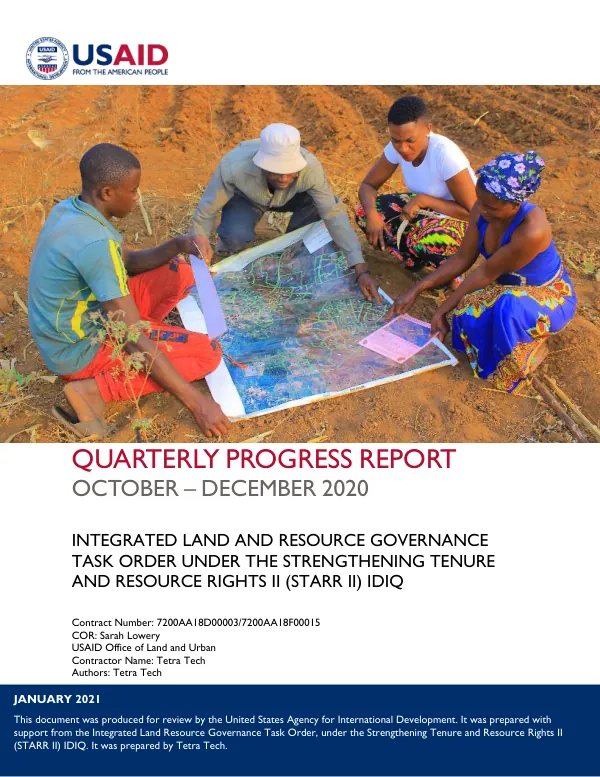
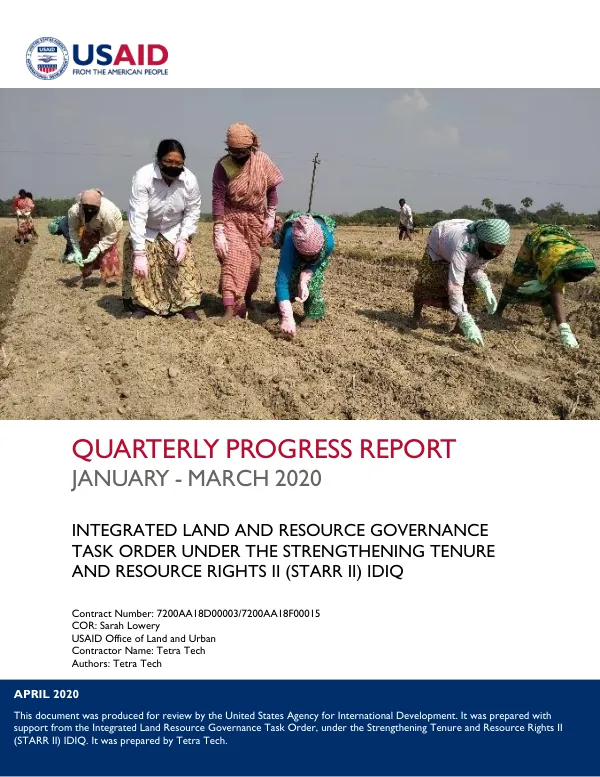
Quarterly Progress Report January – March 2020
The Integrated Land and Resource Governance (ILRG) Task Order under the Strengthening Tenure and Resource Rights II (STARR II) IDIQ has made significant progress in the first quarter of 2020.
2020 · 84 pages
Sign in to readA free account is required to download.
Abstract
The project aims to improve land governance and tenure security for vulnerable populations, including women, indigenous peoples, and small-scale farmers. The COVID-19 pandemic has had a significant impact on the project's implementation. Staff have been affected, with some experiencing health issues, and the project's workplan has been adjusted to accommodate the pandemic. The pandemic has also affected the project's burn rate, with some costs being incurred due to the need for additional measures to prevent the spread of the virus. Despite these challenges, the project has made progress in several areas. In Mozambique, the project has implemented environmental measures to mitigate the impact of land use changes. In Zambia, the project has supported the development of capacity development indicators and tools, and has implemented mobile approaches to secure tenure. In India, the project has supported women's economic empowerment and equality, land rights, and agricultural engagement. The project has also made progress in several other countries, including Indonesia, where a land tenure assessment has been conducted, and Liberia, where community land planning has been supported. In addition, the project has supported the development of a learning agenda, which aims to improve the project's effectiveness and impact. The project has also made progress in several other areas, including the development of a sub-national assessment in Indonesia, and the support of a community land planning initiative in Liberia. The project has also supported the development of a women's global development and prosperity initiative, which aims to improve the economic empowerment of women. The project has also identified several emerging completion activity opportunities, including support for land policy and support in Burma, and support for cocoa production in Madagascar. The project has also developed several project-specific performance indicators, which aim to measure the project's effectiveness and impact. The project has also documented several success stories, including the support of a women's economic empowerment and equality initiative in India, and the development of a land tenure assessment in Indonesia. The project has also provided information on project staff, data, and other relevant information. The project has made significant progress in the first quarter of 2020, despite the challenges posed by the COVID-19 pandemic. The project continues to work towards its goal of improving land governance and tenure security for vulnerable populations.