USAID DEC
Integrated Pest Management Collaborative Research Support Program (IPM CRSP) Impact Spotlight: Papaya Mealybug
Sign inUSAID
Integrated Pest Management Collaborative Research Support Program (IPM CRSP) Impact Spotlight: Papaya Mealybug
The Integrated Pest Management Collaborative Research Support Program (IPM CRSP) identified the presence of the papaya mealybug in Indonesia and India in 2008.
2012 · 1 pages
Sign in to readA free account is required to download.
Abstract
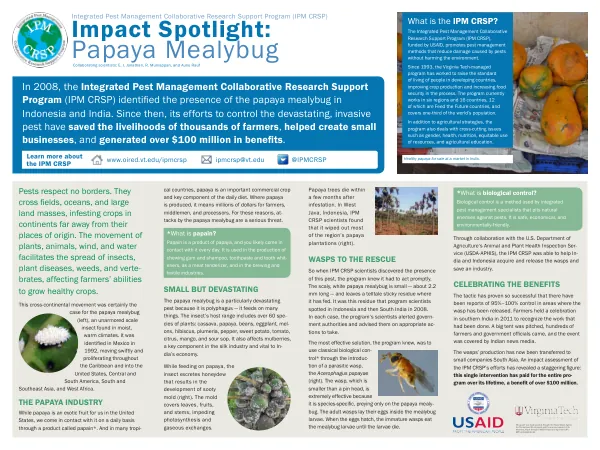
This invasive pest has devastating effects on crops, particularly papaya, and its host range includes over 60 species of plants. The papaya mealybug feeds on papaya, excreting honeydew that results in the development of sooty mold, impeding photosynthesis and gaseous exchanges. Papaya trees die within a few months after infestation, as seen in West Java, Indonesia, where the pest wiped out most of the region's papaya plantations. The IPM CRSP scientists discovered the papaya mealybug in Indonesia and South India in 2008, identifying it through the telltale sticky residue left behind by the insect. The program's scientists alerted government authorities and advised them on appropriate actions to take. The most effective solution was to use classical biological control through the introduction of a parasitic wasp, Acerophagus papayae. This wasp is species-specific, preying only on the papaya mealybug, and has proven extremely effective in controlling the pest. The introduction of the parasitic wasp was made possible through collaboration with the U.S. Department of Agriculture's Animal and Plant Health Inspection Service (USDA-APHIS). The IPM CRSP helped India and Indonesia acquire and release the wasps, saving the papaya industry. Reports have shown 95%–100% control in areas where the wasp has been released, and farmers have celebrated the work done to control the pest. The wasps' production has now been transferred to small companies in South Asia. An impact assessment of the IPM CRSP's efforts has revealed a staggering figure: this single intervention has paid for the entire program over its lifetime, with a benefit of over $100 million. The IPM CRSP promotes pest management methods that reduce damage caused by pests without harming the environment. Funded by USAID, the program has worked to raise the standard of living of people in developing countries, improving crop production and increasing food security. The program currently works in six regions and 16 countries, covering one-third of the world's population, and deals with cross-cutting issues such as gender, health, nutrition, and agricultural education.
Related documents