USAID DEC
Integration of Social and Emotional Learning into Basic Education Programming: Findings from Eight Case Studies
Sign inBANYAN GLOBAL
Integration of Social and Emotional Learning into Basic Education Programming: Findings from Eight Case Studies
Social and emotional learning (SEL) has emerged as a crucial component of quality education, with Sustainable Development Goal (SDG) 4 emphasizing the need for flexible skills and competencies that prepare learners for diverse challenges.
2021 · 9 pages
Sign in to readA free account is required to download.
Abstract
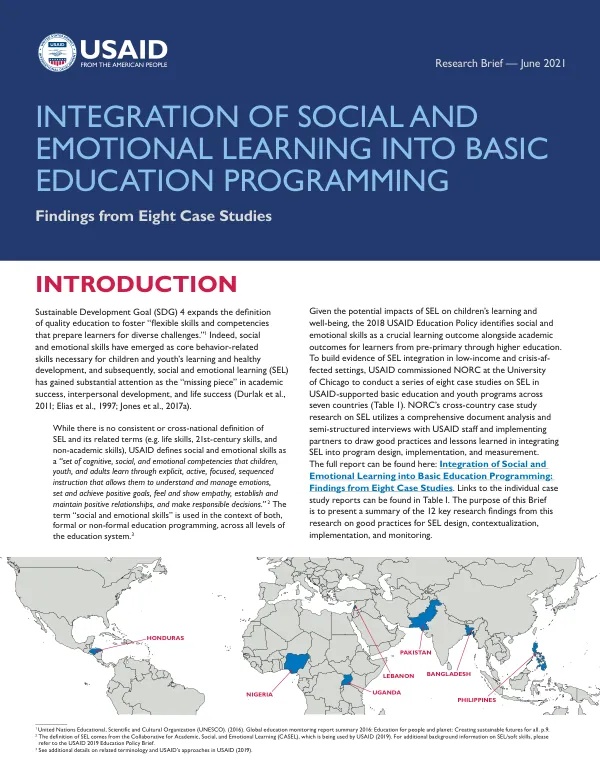
Social and emotional skills have been identified as core behavior-related skills necessary for children and youth's learning and healthy development. The Collaborative for Academic, Social, and Emotional Learning (CASEL) defines SEL as a set of cognitive, social, and emotional competencies that children, youth, and adults learn through explicit, active, focused, sequenced instruction. The 2018 USAID Education Policy identifies social and emotional skills as a crucial learning outcome alongside academic outcomes for learners from pre-primary through higher education. To build evidence of SEL integration in low-income and crisis-affected settings, USAID commissioned NORC at the University of Chicago to conduct a series of eight case studies on SEL in USAID-supported basic education and youth programs across seven countries. The case studies utilized a comprehensive document analysis and semi-structured interviews with USAID staff and implementing partners to draw good practices and lessons learned in integrating SEL into program design, implementation, and measurement. The case studies were conducted in Bangladesh, Honduras, Lebanon, Nigeria, Pakistan, Philippines, and Uganda, with a focus on low-income and crisis-affected settings. The research involved a review of 175 activity documents and 49 virtual key informant interviews with implementing partner and USAID staff. The study period was from April to November 2020. The key findings from the case studies highlight the importance of agreeing on context-appropriate SEL terminology and SEL skills definition with in-country stakeholders. This facilitates effective SEL implementation and ensures that local stakeholders have a strong understanding of SEL and its role in the program. The study also found that incorporating the role of SEL into a theory of change based on identified needs is critical to ensuring a consistent understanding and vision of SEL across stakeholders. In terms of SEL contextualization, the study found that programs should consider the specific needs of the school and community when designing SEL interventions. This involves identifying the specific SEL needs through needs assessments or evaluation findings of predecessor activities. For example, the ALE/Honduras team included SEL in the activity's theory of change to provide young learners with tools to analyze their feelings, regulate emotions, and ultimately improve school retention and safety. The study also found that SEL implementation should be tailored to the specific context and needs of the school and community. This involves working with local stakeholders to develop context-appropriate SEL interventions and ensuring that these interventions are aligned with the program's theory of change. The study highlights the importance of ongoing monitoring and evaluation to ensure that SEL interventions are effective and making a positive impact on learners. Overall, the case studies provide valuable insights into the integration of SEL into basic education programming in low-income and crisis-affected settings. The findings highlight the importance of agreeing on context-appropriate SEL terminology and SEL skills definition, incorporating the role of SEL into a theory of change, and contextualizing SEL interventions to the specific needs of the school and community.