USAID DEC
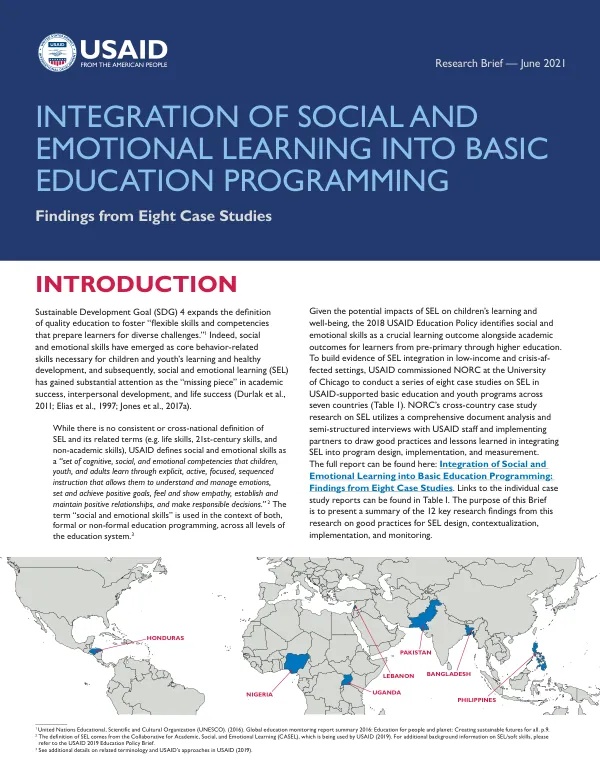
Integration of Social and Emotional Learning into Basic Education Programming: Findings from Eight Case Studies
Sign inNORC AT THE UNIVERSITY OF CHICAGO
Integration of Social and Emotional Learning into Basic Education Programming: Findings from Eight Case Studies
The 2018 USAID Education Policy identifies social and emotional skills, alongside literacy and numeracy skills, as a foundational learning outcome.
2021 · 69 pages
Sign in to readA free account is required to download.
Abstract
USAID commissioned NORC to complete a series of qualitative case studies to understand how social and emotional learning (SEL) is integrated into USAID basic education activities. The research team used document analysis and key informant interviews to answer the following questions: How are social and emotional skills integrated into the conceptualization and design of USAID's basic education activities? How are SEL interventions managed, implemented, and measured? What are the best practices and lessons learned in designing, implementing, and measuring SEL in USAID's basic education activities? How can USAID better support Mission staff to design and manage interventions toward social and emotional skills or outcomes? In designing SEL, key informants emphasized the importance of agreeing with local stakeholders on SEL terminology and related definitions. The majority of activities directly referred to social and emotional skills as a means to achieve other outcomes in the theory of change, such as reading skills, employability, and reduced school-level violence. When activities based such outcomes on the school and community's specific SEL needs, key informants had a more consistent understanding of SEL's role in a theory of change. Much of the contextualization of SEL competence areas and skills occurred later at the skills level after global SEL frameworks and competence areas were adopted. Exceptionally, QITABI 2/Lebanon provided a promising example of contextualizing both competence areas and skills, to develop a locally driven SEL framework. Comparing a global set of skills with a country's education curricula is an effective method of contextualization at the social and emotional skills level. The report highlights a rigorous pilot testing of SEL teaching and learning content with learners and educators to design effective SEL intervention. SEL interventions can advance the educational goal of equity and inclusion by building learners' agency and fostering inclusive school climate. Activities that integrate SEL using multiple approaches across various entry points are considered more effective. Key informants perceived explicit SEL skills instruction as more effective. Integration with school curriculum approaches is effective for practicing and reinforcing social and emotional skills. Key informants also considered child-friendly classroom and school culture approaches as crucial for the education system-wide support for SEL. SEL policy adoption occurred more when the relevant ministry took the lead in SEL implementation. The research team found that SEL teaching and learning content should be contextualized to the local context, and that pilot testing with learners and educators is essential for designing effective SEL interventions. SEL interventions can be effective in advancing equity and inclusion by building learners' agency and fostering inclusive school climate. The report highlights the importance of SEL in USAID's basic education activities, and provides recommendations for how USAID can better support Mission staff to design and manage interventions toward social and emotional skills or outcomes. The research team recommends that USAID provide training and technical assistance to Mission staff on SEL, and that USAID support the development of locally driven SEL frameworks. The report also highlights the importance of SEL in advancing equity and inclusion, and provides recommendations for how USAID can support the development of inclusive school climates. The research team recommends that USAID support the development of SEL policies and guidelines, and that USAID provide technical assistance to countries to develop and implement SEL programs. Overall, the report provides a comprehensive overview of the integration of SEL into USAID's basic education activities, and provides recommendations for how USAID can better support the development of SEL programs. The research team's findings highlight the importance of SEL in advancing equity and inclusion, and provide a framework for how USAID can support the development of effective SEL interventions.