IBI
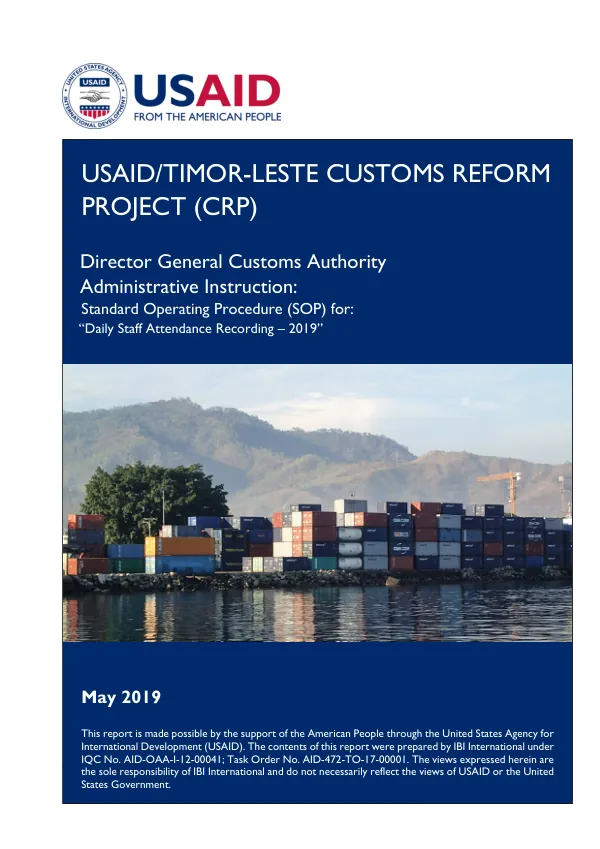
Standard Operating Procedure (SOP) for Daily Staff Attendance Recording – 2019
The Customs Authority in Timor-Leste has implemented a Standard Operating Procedure (SOP) for daily staff attendance recording, effective May 2019.
2019 · 16 pages
Sign in to readA free account is required to download.
Abstract
This SOP is issued by the Director General of the Customs Authority, in accordance with the Customs Organic Law, Decree Law 9/2017, and the Statute of Civil Service, Law No. 8/2004. The objectives of this SOP are to provide clear instructions on who is responsible for applying the provisions, processes to be followed, and the use of standard attendance recording templates. The SOP aims to minimize opportunities for procedural abuse or malfeasance and ensure that all employees, across all levels, working at the Customs Authority, adhere to the daily staff attendance recording procedure. The SOP applies to all employees of the Customs Authority, and the National Director of Administration and Internal Resources (DNARI) is responsible for implementing and standardizing the application of all provisions in the SOP. The DNARI is also responsible for ensuring that all officers have access to a written copy of the SOP, receive appropriate training in the content of the SOP, and take corrective measures in case the provisions are not followed strictly. The SOP requires employees to complete an Attendance Record form by signing in each morning and afternoon. The relevant line manager must review the Attendance Record form each working day to ensure it has been completed correctly and seek clarification from employees for any discrepancies. The HRM Department is responsible for reviewing the staff attendance records and verifying that the form is completed correctly. The HRM Department identifies Customs employees who were absent without justification (AWJ) from the workplace and checks the approved monthly leave records to verify that the employee is not on approved leave. The HRM Department prepares a letter to the DG of Customs, informing the DG of the number of employees who were AWJ from the workplace, and the DG reviews the letter and seeks further information or clarification from the HRM Department if necessary. The DG of Customs approves the letter by signing and dating it, and the HRM Department submits the signed DG letter to the Civil Service Commission (CSC) for processing. The CSC stamps the original cover letter with the date it was submitted, and gives a copy of the stamped letter to Customs. The HRM Department prepares warning letters to Customs employees who were identified as AWJ, informing them that they are in breach of Customs and civil service laws and that failure to comply with relevant laws may result in disciplinary action being taken against employees. The National Director of DNARI reviews the warning letter, seeks clarification if necessary from the HRM Department, and approves by signing the letter. The warning letter template is at ANNEX 4, and the HRM Department files all Customs attendance records in a secure area within DNARI for 3 years before sending them to the National Archives. The SOP requires that all relevant staff apply and enforce this procedure, as per the following laws: the Customs Organic Law, Decree Law 9/2017, the Statute of Civil Service, Law No. 8/2004, and the Customs Code, Decree Law 14/2017. The SOP is updated and circulated to relevant Customs personnel prior to any changes taking effect, and any changes to the SOP must be approved and signed by the Director General.