USAID DEC
Introduction of the Combined Prevention of Postpartum Hemorrhage and Newborn Infection in Madagascar
Sign inJSI RESEARCH & TRAINING INSTITUTE, INC
Introduction of the Combined Prevention of Postpartum Hemorrhage and Newborn Infection in Madagascar
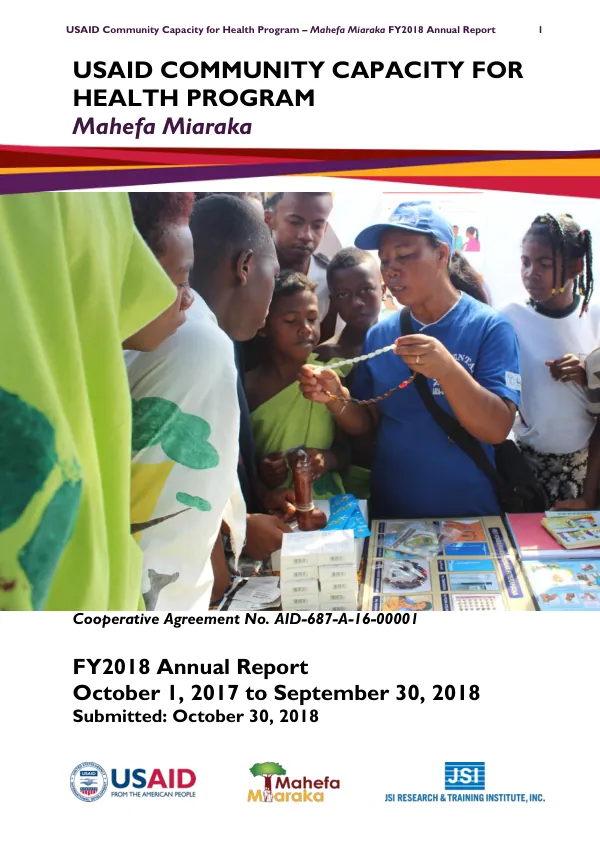
The Combined Prevention of Postpartum Hemorrhage and Newborn Infection in Madagascar was a five-year community health program implemented by the Madagascar Community-Based Integrated Health Program (CBIHP), locally known as MAHEFA, in six remote regions of north and north-west Madagascar.
2016 · 4 pages
Sign in to readA free account is required to download.
Abstract
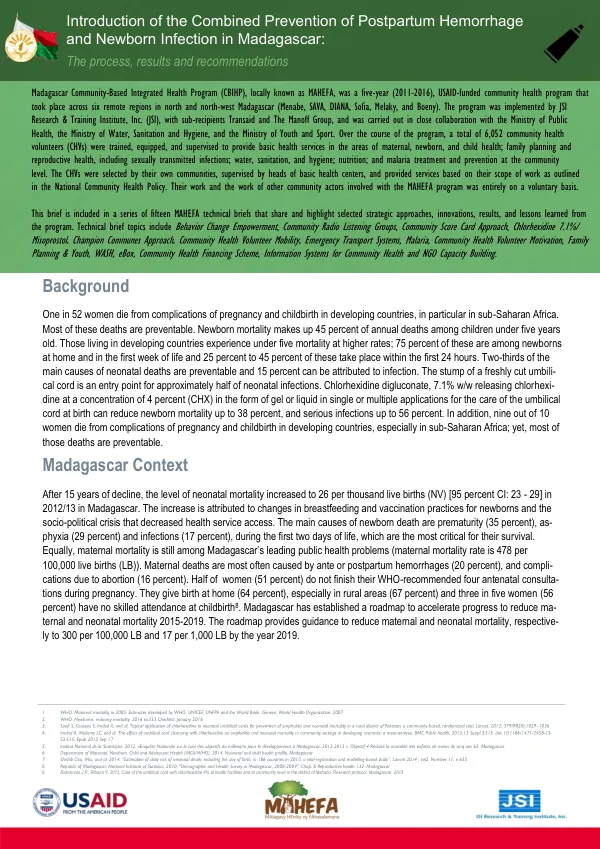
The program was funded by USAID and implemented by JSI Research & Training Institute, Inc. (JSI), with sub-recipients Transaid and The Manoff Group, in close collaboration with the Ministry of Public Health, the Ministry of Water, Sanitation and Hygiene, and the Ministry of Youth and Sport. A total of 6,052 community health volunteers (CHVs) were trained, equipped, and supervised to provide basic health services in the areas of maternal, newborn, and child health; family planning and reproductive health, including sexually transmitted infections; water, sanitation, and hygiene; nutrition; and malaria treatment and prevention at the community level. The program focused on the prevention of postpartum hemorrhage and newborn infection through the introduction of chlorhexidine digluconate, 7.1% w/w releasing chlorhexidine at a concentration of 4 percent (CHX) in the form of gel or liquid for the care of the umbilical cord at birth. The CHX was found to reduce newborn mortality up to 38 percent and serious infections up to 56 percent. The program also aimed to improve maternal health by introducing misoprostol to prevent postpartum hemorrhage. The introduction of CHX and misoprostol was a MAHEFA innovation, combined and driven in two districts, Mahabo and Vohémar. The implementation of the program took place in health facilities and at community level through CHV services that were provided in health huts and in households. The program followed a pre-established research protocol that included advocacy at the local level, development and validation of training and Information, Education and Communication (IEC) and Behavior Change Empowerment (BCE) tools, training of CHVs on the package of messages and use of products, and acquisition and distribution of products. The program also conducted formative research on cord care practices, acceptability of CHX, and willingness to pay, as well as a pre-test of name, logo, and packaging. The program was launched in two MAHEFA districts and activities were carried out according to a pre-established research protocol. The program included training of health workers and CHVs, education and distribution of CHX by CHVs during home visits, sensitization of pregnant women on ANC, delivery, and postnatal care at CSB, post-training monitoring, supervision, postnatal, and joint visits MOH and partners. The program also included a pilot program, scale-up, evaluation, and dissemination. The program aimed to reduce maternal and neonatal mortality in Madagascar, which was one of the leading public health problems in the country. The program's results showed a significant reduction in newborn mortality and serious infections. The program also improved maternal health by reducing postpartum hemorrhage. The program's success was attributed to the introduction of CHX and misoprostol, as well as the training and education of CHVs and pregnant women. The program's results were disseminated to the Ministry of Public Health and other stakeholders, and the program's strategy was scaled up to other districts in Madagascar. The program's impact was also evaluated, and the results were used to inform future health programs in Madagascar. The program's geographic focus was on six remote regions of north and north-west Madagascar, and the program's context was the high maternal and neonatal mortality rates in the country. The program's timeframes were from 2011 to 2016, and the program's recommendations were to continue the implementation of the program in other districts in Madagascar, and to scale up the program's activities to reach more pregnant women and newborns. The program's recommendations also included the need for further research on the program's impact and the need for continued training and education of CHVs and pregnant women.