USAID DEC
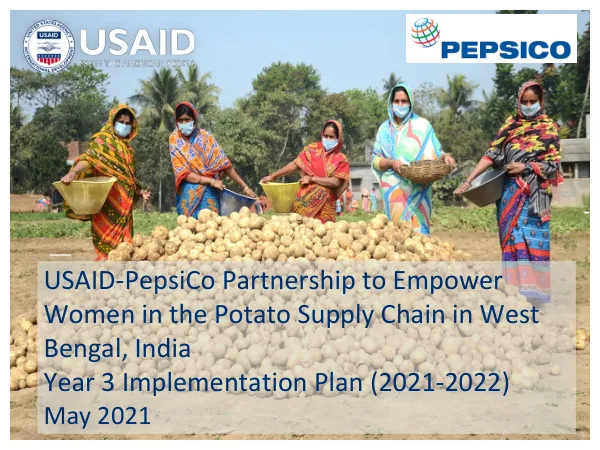
USAID-PepsiCo Partnership to Empower Women in the Potato Supply Chain in West Bengal, India Year 3 Implementation Plan (2021-2022)
Sign inTETRA TECH
USAID-PepsiCo Partnership to Empower Women in the Potato Supply Chain in West Bengal, India Year 3 Implementation Plan (2021-2022)
The USAID-PepsiCo Partnership to Empower Women in the Potato Supply Chain in West Bengal, India, aims to make the business case for women's empowerment within the PepsiCo potato supply chain.
2021 · 43 pages
Sign in to readA free account is required to download.
Abstract
The partnership seeks to demonstrate that reaching, benefiting, and empowering women in the potato supply chain makes social and economic sense for both rural Bengali households and PepsiCo. Strengthening PepsiCo's global and local gender knowledge, awareness, and capabilities is a key strategic approach. This involves leveraging additional partnerships for sustainability and scalability, increasing women's empowerment and gender equality at the farm and community level, and strengthening PepsiCo's internal knowledge and capacity on women's empowerment, gender-based violence, and women's land rights. The partnership targets 70-80% of women in farming families that supply to PepsiCo, who formally and informally work in potato fields. Changing demographics in West Bengal, with increased male migration for work, are expected to increase recognition and capacity of women to manage farms, influencing the sustainability of the farming supply base. A comprehensive approach to the business case for women's empowerment involves making positive changes in attitudes and perceptions, improving brand image, and increasing retention and loyalty of existing farmers. The estimated timeframe for these impacts ranges from 2 to 4 growing seasons. Data collection for the business case includes aligning with Environmental, Social, and Corporate Governance (ESG) language, goals, and reporting. Historical production data will be analyzed to assess changes and trends before and after participation in ILRG interventions, while controlling for weather and other factors. Household-level yield data will be compared with Pro-WEAI scores to assess the benefits of women's empowerment. The partnership aims to track climate change metrics according to tools and standards used by PepsiCo globally. Data will be collected for the Cool Farm Tool for Control Union to prepare the assessment for all ILRG-facilitated demo farms and a sample from each community to extrapolate. Key results from Years 1 and 2 of the partnership include increased women's empowerment and gender equality at the farm and community level. However, challenges were faced in observing increases in yield in contexts where yields are already high. The business case needs to consider internal PepsiCo levers, especially for sustainability and scalability, and has different audiences within PepsiCo with different needs. The partnership's Year 3 implementation plan focuses on increasing women's empowerment and gender equality at the farm and community level, strengthening PepsiCo's global and local gender knowledge, awareness, and capabilities, leveraging additional partnerships for sustainability and scalability, and communications and learning. COVID-19 mitigation and adaptation strategies will also be implemented. Women's access to land and agronomy knowledge will be increased, and men and communities will be engaged to shift gender norms.
Related documents
Documents in this collection
 2019
2019USAID DEC
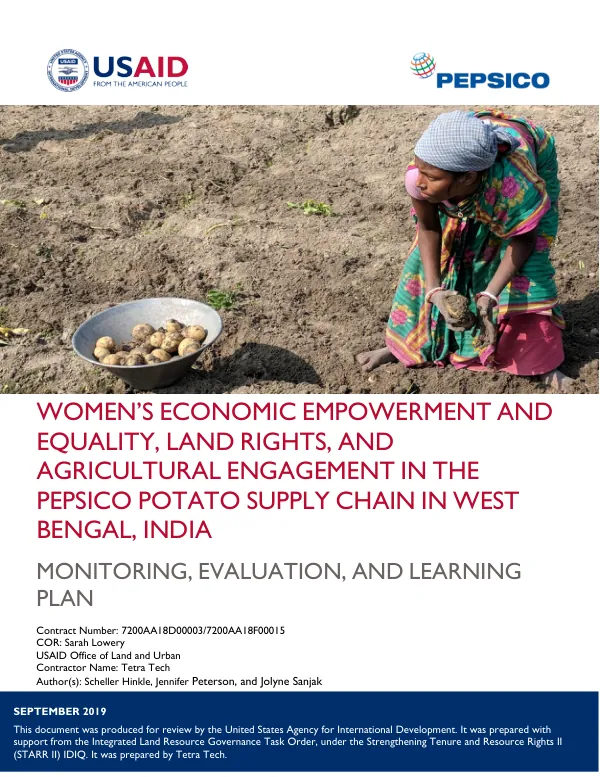
Women’s Economic Empowerment and Equality, Land Rights, and Agricultural Engagement in the PepsiCo Potato Supply Chain in West Bengal, India: Monitoring, Evaluation, and Learning Plan
Open record 2021
2021USAID DEC