ECO CONSULTING GROUP
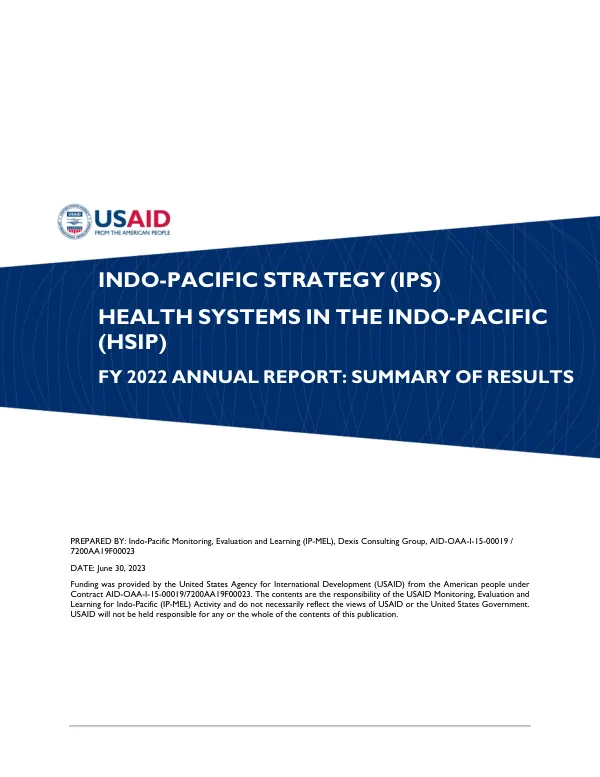
IPS Health Systems in the Indo-Pacific FY 2022 Annual Report: Summary of Results
The Indo-Pacific Strategy (IPS) is a whole-of-government commitment to advancing a free and open, connected, prosperous, secure, and resilient Indo-Pacific region.
2023 · 116 pages
Sign in to readA free account is required to download.
Abstract
The IPS aims to promote economic growth, stability, and security in the region, while also addressing global challenges such as climate change, pandemics, and terrorism. The strategy is guided by a set of core principles, including respect for sovereignty, territorial integrity, and the rule of law. The Health Systems in the Indo-Pacific (HSIP) program is a key component of the IPS, with the goal of strengthening health systems in the region to improve health outcomes and reduce health disparities. The HSIP program focuses on improving access to quality health services, increasing health financing, and enhancing health governance and leadership. The program also aims to address specific health challenges, such as infectious diseases, maternal and child health, and non-communicable diseases. The HSIP FY 2022 Annual Report highlights key results and achievements from the past year. One of the major successes was the expansion of health services to underserved populations, including those living in remote and hard-to-reach areas. The program also made significant progress in improving health financing, with a focus on increasing domestic resource mobilization and improving the efficiency of health spending. Another key area of focus for the HSIP program is the control and prevention of infectious diseases, including tuberculosis, HIV/AIDS, and malaria. The program has made significant progress in improving case detection and treatment, as well as increasing access to antiretroviral therapy and other life-saving medications. The HSIP program has also worked to strengthen health systems and improve health governance, including through the development of national health policies and strategies. The HSIP program has also made significant progress in improving maternal and child health, including through the expansion of skilled birth attendance and the improvement of emergency obstetric care. The program has also worked to reduce maternal and child mortality rates, as well as improve access to family planning services. In addition to these achievements, the HSIP program has also made significant progress in improving health information systems and data use. The program has worked to strengthen health information systems, including through the development of electronic health records and the improvement of data quality and analysis. The program has also worked to increase the use of data for decision-making, including through the development of data-driven policies and programs. Overall, the HSIP FY 2022 Annual Report highlights the significant progress made by the program in improving health outcomes and reducing health disparities in the Indo-Pacific region. The program's focus on strengthening health systems, improving health financing, and addressing specific health challenges has made a meaningful difference in the lives of millions of people in the region.