USAID DEC
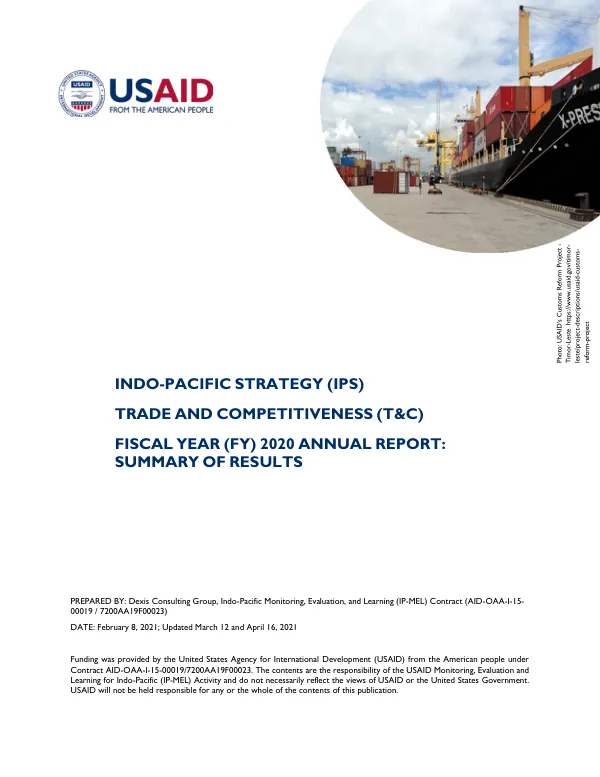
FY 2020 Summary Report: Indo-Pacific Strategy (IPS) Trade and Competitiveness (T&C) Annual Report: Summary of Results
Sign inECO CONSULTING GROUP
FY 2020 Summary Report: Indo-Pacific Strategy (IPS) Trade and Competitiveness (T&C) Annual Report: Summary of Results
The Indo-Pacific Strategy (IPS) Trade and Competitiveness (T&C) program is a whole-of-government initiative aimed at enhancing trade facilitation, improving market-based trade and competitiveness laws and policies, and increasing private sector participation in the Indo-Pacific region.
2021 · 41 pages
Sign in to readA free account is required to download.
Abstract
The program is one of six Initiatives/Program Focus Areas under the IPS, with USAID playing a leading role in helping Indo-Pacific partners implement trade-based development strategies. The overall goal of T&C is to increase inclusive, broad-based, and sustained free and fair trade and competitiveness in the Indo-Pacific region. This goal is supported by four interconnecting Outcomes, related Intermediate outcomes, and four Cross-cutting Outcomes. The T&C Theory of Change (TOC) argues that improved trade facilitation and customs processes, market-based trade and competitiveness laws and policies, private sector capacity and participation, and ease of doing business are essential for increasing inclusive, broad-based, and sustained free and fair trade and competitiveness. The Results Framework illustrating this logic is presented below. The USAID T&C Theory of Change was originally designed in 2019 and updated in 2020. It is based on the contextual assumptions that inclusive, broad-based growth is growth across multiple sectors, and inclusive of most of the country's labor force. The program's Outcomes are: 1. Trade facilitation and customs processes improved, with host country capacity to meet TFA commitments strengthened, non-tariff border restrictions reduced, and customs or other border clearance infrastructure developed or improved. 2. Market-based trade and competitiveness laws, policies, and regulations improved, with institutional capacity for trade and competitiveness government counterparts strengthened, market-based trade and competitiveness laws, policies, and regulations adopted and effectively enforced. 3. Private sector participation and capacity increased, with property rights enforcement strengthened, access to market-based finance for private enterprises improved, and private sector participation in global value chains increased. 4. Ease of doing business improved, with contract enforcement improved, regulatory burdens and costs of doing business reduced, and transparency of business regulations improved. The program's Cross-cutting Outcomes are: 1. Labor and environment standards enhanced. 2. Gender equality and social inclusion integrated in all outcomes. 3. Private sector and civil society engagement increased, with effective advocacy for market-based reforms increased. 4. Governance strengthened. The program's contextual assumptions include: 1. Economic growth and stability in the region continue without any major economic crises. 2. The political climate in the Indo-Pacific countries is relatively stable. 3. Foreign investment, especially from the U.S., continues to flow into the region at high levels or increase. 4. Countries in the Indo-Pacific region have the political will and capacity to substantially reform their external trade and trade-related investment policies. The COVID-19 global pandemic presents some challenges and opportunities to the continuation of market growth in the Indo-Pacific region.
Related documents