IOM
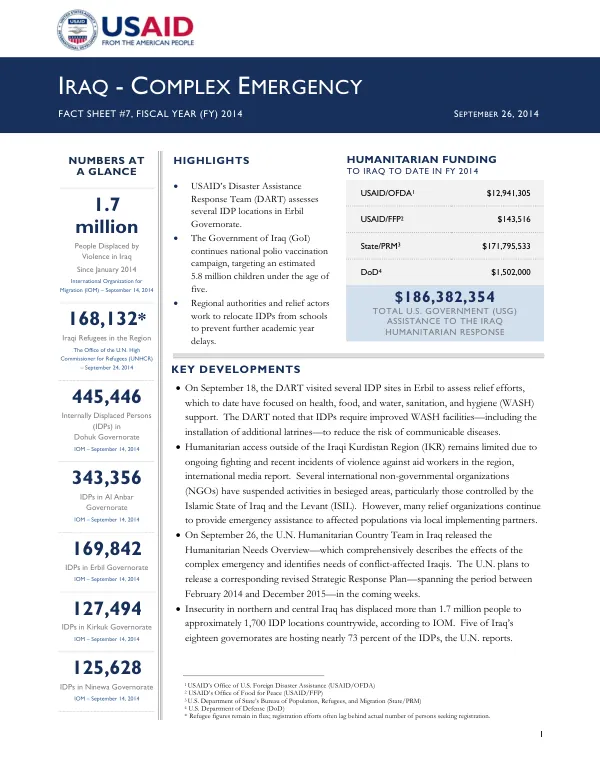
Iraq - Complex Emergency Fact Sheet #7, Fiscal Year (FY) 2014
The humanitarian crisis in Iraq has resulted in a significant displacement of people, with over 1.7 million internally displaced persons (IDPs) residing in various governorates across the country.
2014 · 7 pages
Sign in to readA free account is required to download.
Abstract
The majority of IDPs are residing in the governorates of Dohuk, Al Anbar, Al Anbar, and Erbil, with the largest number of IDPs in Dohuk Governorate, totaling approximately 445,356 individuals. The IDPs are residing in a variety of settings, including schools, unfinished buildings, and camps. Humanitarian access to the affected areas remains limited due to ongoing fighting and violence against aid workers. Several international non-governmental organizations (NGOs) have suspended activities in besieged areas, particularly those controlled by the Islamic State of Iraq and the Levant (ISIL). However, many relief organizations continue to provide emergency assistance to affected populations via local implementing partners. The U.N. Humanitarian Country Team in Iraq has released the Humanitarian Needs Overview, which comprehensively describes the needs of conflict-affected Iraqis. The report highlights the need for improved WASH facilities, including the installation of additional latrines, to reduce the risk of communicable diseases. The report also emphasizes the importance of providing emergency assistance to affected populations, including food, shelter, and health services. The U.S. government has provided significant funding to support the humanitarian response in Iraq. The U.S. Department of State's Bureau of Population, Refugees, and Migration (State/PRM) has provided $171,795,533 in funding, while the U.S. Department of Defense (DoD) has provided $1,502,000. The U.S. Agency for International Development (USAID) has also provided significant funding, with $12,941,935 allocated for the Disaster Assistance Response Team (DART) and $143,516 allocated for the Office of Food for Peace (FFP). The humanitarian response in Iraq is ongoing, with relief organizations working to provide emergency assistance to affected populations. The U.N. is planning to conduct an interagency assessment and humanitarian response mission for the approximately 900 returnee families in Al Qosh, while the IOM is working to provide shelter and assistance to IDPs in various governorates. The WASH sector is also working to improve access to safe drinking water and sanitation facilities, particularly in the governorates of An Najaf, Al Qadisiyah, and Al Basrah. The humanitarian crisis in Iraq is a complex and ongoing issue, with ongoing fighting and violence affecting the ability of aid workers to access affected areas. However, despite these challenges, relief organizations continue to work tirelessly to provide emergency assistance to affected populations. The U.S. government has provided significant funding to support the humanitarian response, and the humanitarian response is ongoing, with relief organizations working to provide emergency assistance to affected populations.
Related documents