IRC
USG Syria Complex Emergency Fact Sheet #7 - FY 2013
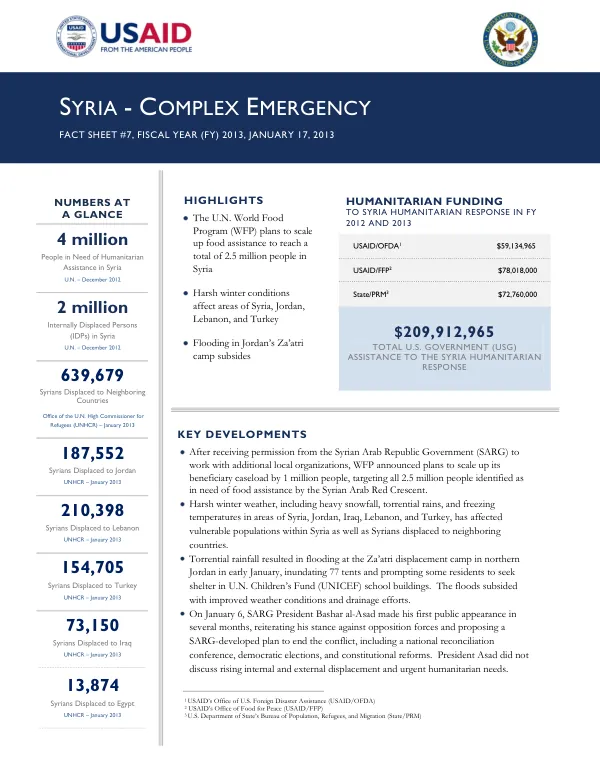
The Syrian Arab Republic Government (SARG) granted permission to the World Food Program (WFP) to scale up its beneficiary caseload by 1 million people, targeting all 2.5 million people identified as in need of food assistance by the Syrian Arab Red Crescent.
2013 · 8 pages
Sign in to readA free account is required to download.
Abstract
This decision was made after WFP received permission to work with additional local organizations. Harsh winter weather conditions, including heavy snowfall, torrential rains, and freezing temperatures, have affected vulnerable populations within Syria as well as Syrians displaced to neighboring countries. In Jordan, flooding at the Za'atri displacement camp in northern Jordan in early January inundated 77 tents and prompted some residents to seek shelter in U.N. Children's Fund (UNICEF) school buildings. The floods subsided with improved weather conditions and drainage efforts. The U.S. Government (USG) has supported multiple partner organizations to provide winterization kits to people affected by the crisis and prevailing weather conditions in Syria and in neighboring countries. One USG-funded non-governmental organization (NGO) is working in collaboration with local partners to provide 6,000 kits each week for distribution across Syria. USG-supported winterization efforts are scheduled to continue through the end of the winter season. Concurrently, the USG is also providing household items and hygiene supplies to help families meet basic household needs. USG partner UNICEF has reached approximately 263,000 people in Syria with winter supplies, including in Damascus, Rif Damascus, Homs, Al Hasakah, Tartus, and Ar Raqqah governorates. The high level of displacement and distrust generated by the conflict has weakened traditional community support mechanisms for psychological distress. A study released in January by the International Rescue Committee (IRC) reports that incidents of rape and other forms of sexual violence are increasingly common in Syria, contributing to an elevated level of psychological distress. The price of food and other basic commodities in Syria continues to increase, straining the ability of conflict-affected households to purchase sufficient food, according to relief agencies. WFP reports that long lines for bread are now commonplace throughout Syria, as many bakeries have closed or been damaged during the conflict. In January, WFP received permission from the SARG to import fuel and wheat flour for humanitarian purposes, potentially easing humanitarian conditions in the country. Only 5 percent of farmers surveyed in Syria reported harvesting their entire winter wheat and barley crops, while 20 percent were unable to harvest any crops due to the ongoing conflict in Syria. Médecins Sans Frontières, an NGO operating inside Syria, recently reported publicly that SARG forces are heavily targeting hospitals in contested areas. IRC also reports that partner organizations have observed a systematic campaign to restrict access to emergency health care services through the strategic destruction and forced closures of hospitals and health care facilities. Despite significant insecurity, USG partners continue to support emergency medical care by providing medical supplies, equipment, and training for first responders and other medical personnel. The U.N. World Health Organization (WHO), in cooperation with the SARG Ministry of Health and UNICEF, completed a vaccination campaign in late December reaching 1.5 million children with polio vaccine and 1.3 million children with measles vaccine. According to UNHCR, the number of registered Iraqi refugees in Syria has decreased from 84,000 in October 2012 to 63,000 in January 2013. The majority of Iraqi refugees remaining in Syria live in and around Damascus, with the total Iraqi refugee population outside of Damascus currently at 16,412 individuals, or 26 percent of the registered population in the country. Starting in early January, media outlets reported that Palestinian factions in the Yarmouk neighborhood of Damascus, where 150,000 of Syria's 525,000 Palestinian refugees reside, are attempting to negotiate a ceasefire between opposition and SARG forces to allow for the safe return of Palestinian residents. To ease overcrowding in camps for displaced Syrians in Turkey, officials have started setting up additional family tents in Akcakale and Kahramanmaras camps. In the border town of Nizip, a new camp is being established to accommodate an additional 10,000 displaced Syrians. The U.N. Relief and Works Agency for Palestine Refugees in the Near East (UNRWA) reports that it has had to close many of its facilities in Damascus, including all facilities in Yarmouk, due to the fighting. UNRWA is providing shelter, food, and other assistance to Palestinian refugees who have fled Yarmouk in nearby UNRWA facilities.