USAID DEC
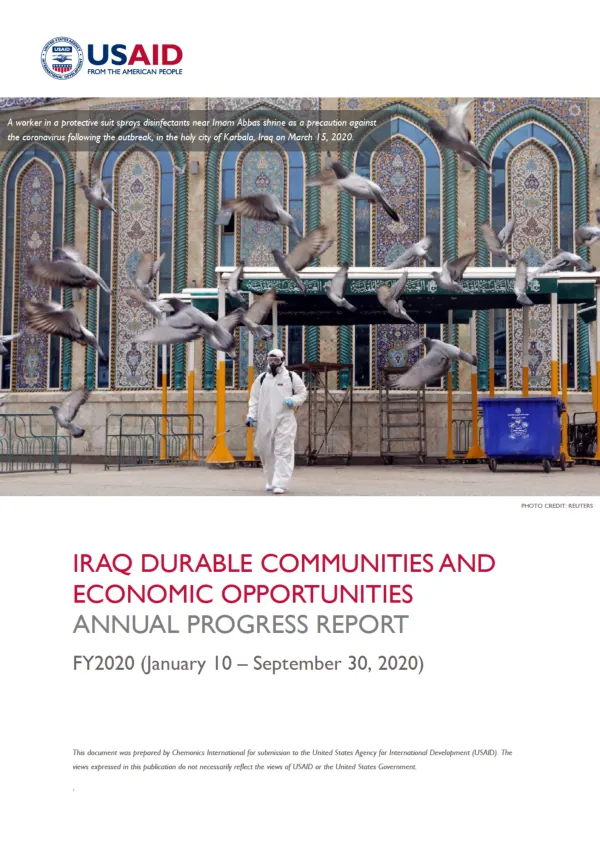
Iraq Durable Communities and Economic Opportunities (DCEO) Annual Report FY2020
The Iraq Durable Communities and Economic Opportunities (DCEO) project was awarded on September 29, 2018, and following protests, a stop work order was issued on October 4, 2018.
2020 · 81 pages
Sign in to readA free account is required to download.
Abstract
The stop work order was rescinded on January 9, 2020, and DCEO began mobilization on January 10, 2020. The project's initial focus was on building a strong network of contacts in Iraq, including the private sector, stabilization of selected communities, and programming under the Marla Ruzicka Iraqi War Fund. The project's design was co-created with USAID, and the learnings from the first three baseline assessments, which examined gender, conflict, and political economy in eight governorates, played a valuable role in the project's implementation. These early exercises bore fruit in the eventual inclusion of two key sub-contractors in the implementation task orders. Five One Labs and Preemptive Love Coalition were included in the implementation task orders. As Quarter 2 drew to a close, the shape of the two implementation task orders became clear in the co-creation process. The first COVID-19 cases were reported in early March, and the KRG responded swiftly, imposing curfews and movement restrictions between provinces. Federal Iraq followed suit soon thereafter, and by mid-March, the entire country was on lockdown, including the closure of both Erbil and Baghdad International Airports. The senior management team, consisting of USN and TCN staff, was evacuated to approved safe havens and adapted to remote management practices based on years of experience in dangerous environments. In Quarter 3, despite the management team being evacuated and the team of Iraqi national staff being new and growing, DCEO completed and submitted the political economy, conflict, and gender assessments to USAID. The Technical Advisory Team, supported by subcontractor iMMAP, further refined the analysis, basing the findings on data collected from the targeted communities. This work enabled DCEO to make recommendations to USAID regarding geographically specific corridors for BCJCI and communities for 100 Solutions. The award and mobilization of the Learning Task Order at the end of July engendered a rich discussion with USAID on the formulation of learning questions to inform the development of an Implementation Plan. This task order has also given DCEO and USAID an opportunity to reflect on how best to test the validity of the overarching theory of change and the relationship between activities and outcomes. The COVID-19 pandemic has been a universal and pervasive factor in daily life internationally, and DCEO has approached it as a reality that must be factored and dealt with, and as a risk that requires planning and mitigation in order to manage. The project has made optimal use of communications platforms, transitioning to remote working in order to comply with local restrictions and safety procedures set by the management team. The DCEO Senior Management Team evacuated in March 2020 following the ordered departure from Iraq. The team has continued to work remotely, using a variety of platforms and techniques to establish relationships with stakeholders, hire and onboard staff, ensure the readiness of facilities, and handle financial arrangements in Iraq. The team has also conducted the research and analysis encapsulated in the updates to the baseline political economy, conflict, and gender assessments, drilling down to the provincial level. The project has made significant progress, despite the challenges posed by the pandemic. The Learning Task Order has been a magnet for thought and a platform for exchange of views. The project has also enabled DCEO to make recommendations to USAID regarding geographically specific corridors for BCJCI and communities for 100 Solutions. The project's implementation has been supported by the Technical Advisory Team, which has further refined the analysis, basing the findings on data collected from the targeted communities. The project has also enabled DCEO to make recommendations to USAID regarding the relationship between activities and outcomes. The project's focus has been on building a strong network of contacts in Iraq, including the private sector, stabilization of selected communities, and programming under the Marla Ruzicka Iraqi War Fund. The project has also enabled DCEO to make recommendations to USAID regarding the integration of the two implementation task orders in an IDIQ environment. The project's focus has been on building a strong network of contacts in Iraq, including the private sector, stabilization of selected communities, and programming under the Marla Ruzicka Iraqi War
Related documents