USAID DEC
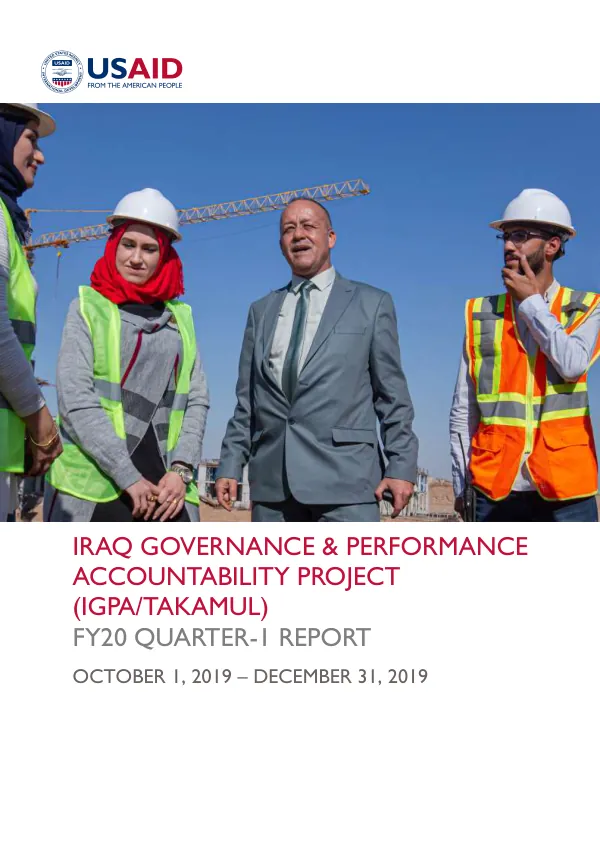
Iraq Governance & Performance Accountability Project (IGPA/Takamul) FY20 Quarter-1 Report
Sign inDAI GLOBAL, LLC
Iraq Governance & Performance Accountability Project (IGPA/Takamul) FY20 Quarter-1 Report
The Iraq Governance and Performance Accountability Project (IGPA/Takamul) is a USAID-funded initiative aimed at enhancing the service delivery capacity of the Government of Iraq.
2020 · 172 pages
Sign in to readA free account is required to download.
Abstract
The project's primary objective is to improve service delivery outcomes in sectors with high impact and visibility, strengthen the strategic approach and capacity of federal line ministries and provincial directorates, enhance regulatory and procedural certainty to attract private sector investment, and target capital investment spending in service delivery sectors that serve vulnerable and disadvantaged populations. To achieve these objectives, IGPA/Takamul has implemented various interventions, including assistance to the Ministry of Finance and Ministry of Oil, KRG Information Systems Reforms, Ninewa Investment Facilitation Initiative, and Anti-Domestic Violence Legislation. The project has also established a monitoring, evaluation, and learning (MEL) framework to track progress and identify areas for improvement. One of the key results of the project is the improvement in service delivery outcomes. According to the project's monitoring data, 43% of citizens reported improvements to service delivery platforms in FY3. Additionally, the project has supported the development of business process reengineering (BPR) plans, which aim to improve the efficiency and effectiveness of public services. IGPA/Takamul has also made significant progress in strengthening the capacity of change agents, including women and vulnerable populations, to represent their needs within the government decision-making processes. The project has trained over 1,000 change agents and supported the development of advocacy plans to promote the interests of marginalized communities. In terms of financial management, the project has supported the development of financial procedures and oversight mechanisms to improve the transparency and accountability of public finances. The project has also worked with the Ministry of Finance to enhance revenue generation, collection, and management outside of the oil sector. The project's success stories include the revitalization of Hamdaniya, the opening of a bank account by the Wasit province, and the mobilization of citizens to avert a water crisis. These achievements demonstrate the project's impact on improving service delivery outcomes, strengthening the capacity of change agents, and enhancing financial management practices. Overall, IGPA/Takamul has made significant progress in achieving its objectives and has contributed to the improvement of service delivery outcomes, financial management practices, and the capacity of change agents in Iraq. The project's success has been recognized through various awards and recognition, including the USAID's Excellence in Development Award. The project's monitoring and evaluation framework has been instrumental in tracking progress and identifying areas for improvement. The framework has been used to develop a complexity-aware monitoring (CAM) approach, which takes into account the complex and dynamic nature of the project's interventions. In terms of challenges and lessons learned, the project has faced various obstacles, including the lack of investment budget approval, which has impacted the project's ability to achieve its targets. However, the project has adapted to these challenges by developing contingency plans and seeking support from stakeholders. The project's implementation strategy has been guided by a conflict sensitivity analysis, which has helped to identify potential risks and develop mitigation strategies. The project has also worked closely with the Government of Iraq and other stakeholders to ensure that its interventions are aligned with national priorities and policies. Overall, IGPA/Takamul has demonstrated its commitment to improving service delivery outcomes, strengthening the capacity of change agents, and enhancing financial management practices in Iraq. The project's success has been recognized through various awards and recognition, and its lessons learned have contributed to the development of best practices in project implementation.
Related documents